

The Theological and Historical Foundations of the Qibla Direction
The Qibla is far more than a physical compass bearing for daily prayers. It represents the spiritual axis of the Islamic faith, uniting millions of individuals across the globe in a single, focused orientation. Whenever a Muslim prepares for Salah, establishing the correct Qibla direction toward the Kaaba in Mecca is a fundamental requirement. However, the Kaaba was not the original focal point for the early Muslim community. The first Qibla was oriented toward Masjid al-Aqsa in Jerusalem. Understanding why the Qibla changed from Jerusalem to Mecca requires a deep dive into early Islamic history, the socio-religious dynamics of Medina, and the explicit Quranic verses that guided this monumental transition.
The Era of the First Qibla
For the first decade of Prophethood in Mecca, and for approximately sixteen to seventeen months after the Hijra to Medina, Muslims faced Jerusalem during their prayers. Masjid al-Aqsa holds a highly venerated status in Islam. It is recognized as a sacred sanctuary and the destination of the Prophet’s Night Journey. Facing Jerusalem initially aligned the early Muslims with the ancient prophetic tradition, creating a visible theological bridge with the existing Abrahamic faiths, particularly Judaism and Christianity.
During the Meccan period, Prophet Muhammad would often stand south of the Kaaba to pray, thereby facing both the Kaaba and Jerusalem simultaneously. Once the community migrated to Medina, this geographical alignment was no longer possible. Medina is located north of Mecca. To face Jerusalem, Muslims had to turn their backs to the Kaaba.
Social and Religious Dynamics in Medina
The migration to Medina introduced a complex new environment. Medina was home to established Jewish tribes who also faced Jerusalem during their worship. The shared prayer direction initially fostered a sense of common monotheistic heritage. Over time, theological debates and social frictions emerged. Historical accounts note that some members of the local communities in Medina used the shared prayer direction as a point of contention, claiming that the Muslims lacked their own independent religious foundation and were merely borrowing from older traditions.
Prophet Muhammad experienced a deep internal longing for the Kaaba. The Kaaba represented the pure monotheism of Prophet Abraham, which Islam sought to restore. The Prophet would frequently look up to the sky, silently awaiting divine guidance on this matter, hoping for a command that would reunite his followers with the sacred house built by Abraham and Ishmael.
The Divine Mandate: Quranic Verses on the Qibla Change
The shift in direction was not a human political decision. It was a divine mandate recorded permanently in the Quran. In the second year of the Hijra, verses from Surah Al-Baqarah were revealed to Prophet Muhammad. These verses directly addressed the change of the Qibla direction, providing both the command to turn toward Mecca and the theological reasoning behind the shift. Allah addresses the Prophet’s silent anticipation in Surah Al-Baqarah, verse 144:
“We have certainly seen the turning of your face toward the heaven, and We will surely turn you to a qiblah with which you will be pleased. So turn your face toward al-Masjid al-Haram. And wherever you believers are, turn your faces toward it in prayer.”
This verse officially established the Kaaba in Mecca as the permanent Qibla. It validated the Prophet’s prayers and realigned the physical and spiritual focus of the Muslim world forever.
The Quran also preemptively addressed the criticism that would inevitably arise from skeptics in Medina. Surah Al-Baqarah, verse 142 states:
“The foolish among the people will say, ‘What has turned them away from their qiblah, which they used to face?’ Say, ‘To Allah belongs the east and the west. He guides whom He wills to a straight path.'”
Core Reasons for the Change of Direction
The change of Qibla served multiple critical purposes in the formation of the early Muslim community.
A Test of Sincere Faith
First, it was a profound test of loyalty. The sudden geographic pivot required absolute obedience. It distinguished the sincere believers who followed the divine command without hesitation from those who were attached to external validation or local customs. The Quran explicitly states in Surah Al-Baqarah, verse 143:
“And We did not make the qiblah which you used to face except that We might make evident who would follow the Messenger from who would turn back on his heels.”
Establishing an Independent Identity
Second, it cultivated a unique, independent religious identity. By turning to the Kaaba, Islam differentiated itself visually and ritually from other Abrahamic faiths. The Muslim community was established as a distinct middle nation with its own central sanctuary, stepping out of the shadow of older religious traditions in the region.
Restoring the Legacy of Abraham
Third, the shift represented a return to the roots of Abrahamic monotheism. The Kaaba is revered in Islamic tradition as the first house of worship built for the one God. By directing prayers toward Mecca, Muslims were not adopting a new innovation. They were reclaiming the ancient, unadulterated legacy of Prophet Abraham, stripping away the idols that the polytheists had placed inside the sanctuary over the centuries.
The Physical Pivot at Masjid al-Qiblatayn
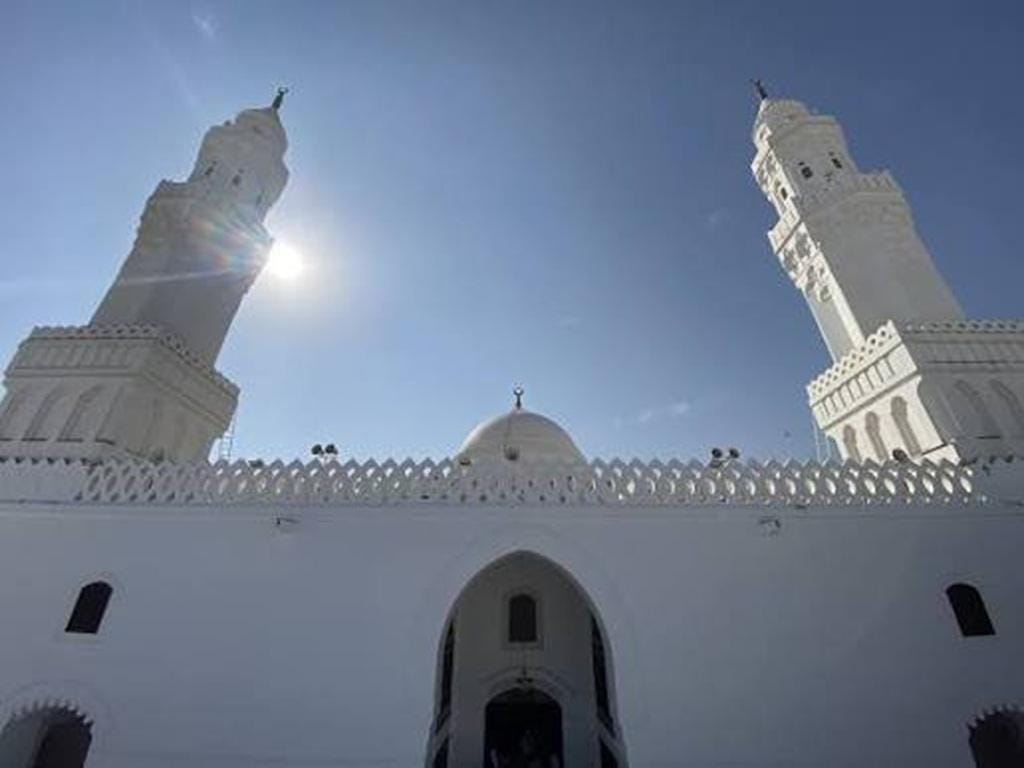
The actual implementation of this command occurred dynamically during a congregational prayer. Historical records indicate that Prophet Muhammad was leading the afternoon prayer when the revelation descended. Mid prayer, the Prophet physically turned his body 180 degrees from the north facing Jerusalem to the south facing Mecca. The congregation seamlessly followed his movement without breaking their prayer.
The mosque where this extraordinary event took place is located in Medina and is known today as Masjid al-Qiblatayn, translating to the Mosque of the Two Qiblas. This architectural landmark stands as a physical testament to this pivotal moment in Islamic history.
The Unifying Power of the Kaaba
The transition from Masjid al-Aqsa to the Kaaba is a watershed moment that finalized the geographical coordinates of the Islamic faith. It reinforced the concept that holiness in Islam is not restricted to a single piece of land, but rather hinges on obedience to the divine will. Today, the Kaaba serves as the unifying center for over a billion Muslims. Regardless of their geographic location, cultural background, or native language, every Muslim calculates their exact Qibla direction toward that singular cube in Mecca. This daily synchronization fosters an unparalleled sense of global unity and continuous connection to the very origins of the faith.