

Follow this stage-by-stage guide to praying the two Sunnah of Fajr, morning Adhkar, and Salatul Ishraq after sunrise to earn a complete Hajj and Umrah reward.
Fajr Sunnah and Salatul Ishraq: Complete Prayer Guide
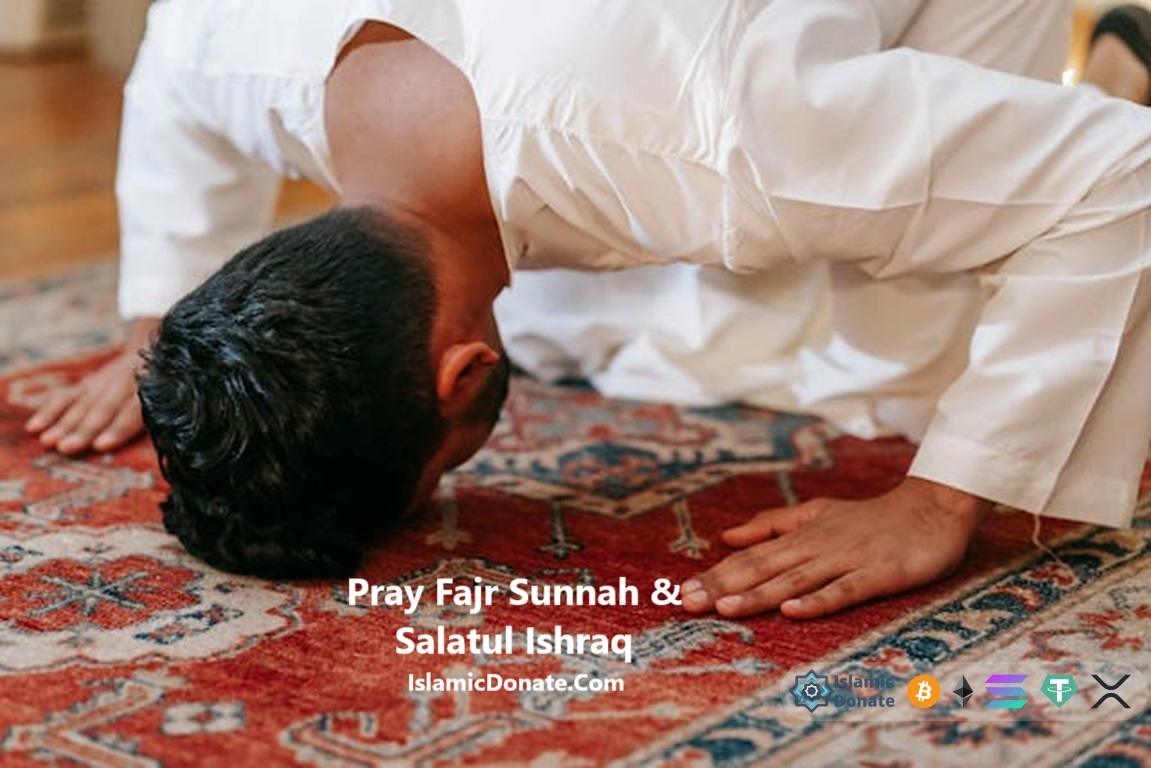
Why are the two Sunnah of Fajr and Salatul Ishraq so important in Ramadan?
The window stretching from the break of true dawn (Fajr) until roughly twenty minutes after sunrise holds two of the highest-yielding voluntary prayers in Islam. First, Aisha (may Allah be pleased with her) reported in Sahih Muslim (725) that the Prophet (peace be upon him) never guarded any voluntary prayer as strictly as the two Sunnah Rak’ahs before the obligatory Fajr prayer, declaring that those two units are better than the entire world and everything in it. Second, Anas ibn Malik narrated in Jami` at-Tirmidhi (586) that whoever prays Fajr in congregation, remains seated remembering Allah until the sun rises, and then prays two Rak’ahs (Salatul Ishraq, the earliest form of Salatul Duha) receives the complete reward of a Hajj and an Umrah.
“Whoever prays Fajr in congregation, then sits remembering Allah until the sun has risen, then he prays two Rak’ah, then for him is the reward like that of a Hajj and Umrah.” (Book 6, Hadith 43)
Connecting this morning routine to our Ramadan daily worship and Suhoor schedule transforms every fasting morning into a spiritual pilgrimage. To multiply your morning reward further, pair your sunrise prayer with direct charity: you can calculate and pay your annual Ramadan Zakat or sponsor hot Iftar meals for displaced orphans on IslamicDonate.Com, knowing our volunteer team absorbs 100 percent of operational overhead so every cent feeds those in need.
How do you perform the Fajr Sunnah, morning Adhkar, and Salatul Ishraq stage by stage?
Follow this four-stage progression from the moment the Fajr Adhan concludes until fifteen minutes after sunrise:
Stage 1: Pray two light Rak’ahs of Fajr Sunnah
After the Fajr Adhan finishes, stand to pray the two confirmed Sunnah Rak’ahs before the obligatory Fajr prayer. It is a prophetic Sunnah to keep these two Rak’ahs concise and to recite Surah Al-Kafirun (Chapter 109) after Al-Fatihah in the first Rak’ah, and Surah Al-Ikhlas (Chapter 112) after Al-Fatihah in the second Rak’ah (Sahih Muslim 726):
- First Rak’ah (Surah Al-Kafirun):
- Arabic: قُلْ يَا أَيُّهَا الْكَافِرُونَ لاَ أَعْبُدُ مَا تَعْبُدُونَ وَلاَ أَنْتُمْ عَابِدُونَ مَا أَعْبُدُ وَلاَ أَنَا عَابِدٌ مَا عَبَدْتُمْ وَلاَ أَنْتُمْ عَابِدُونَ مَا أَعْبُدُ لَكُمْ دِينُكُمْ وَلِيَ دِينِ
- Transliteration: Qul ya ayyuhal-kafirun. La a’budu ma ta’budun. Wa la antum ‘abiduna ma a’bud. Wa la ana ‘abidum-ma ‘abadtum. Wa la antum ‘abiduna ma a’bud. Lakum dinukum wa liya din.
- Translation: “Say: O disbelievers, I do not worship what you worship. Nor are you worshippers of what I worship. Nor will I be a worshipper of what you worship. Nor will you be worshippers of what I worship. For you is your religion, and for me is my religion.”
- Second Rak’ah (Surah Al-Ikhlas):
- Arabic: قُلْ هُوَ اللَّهُ أَحَدٌ اللَّهُ الصَّمَدُ لَمْ يَلِدْ وَلَمْ يُولَدْ وَلَمْ يَكُنْ لَهُ كُفُوًا أَحَدٌ
- Transliteration: Qul Huwallahu Ahad. Allahus-Samad. Lam yalid wa lam yulad. Wa lam yakul-lahu kufuwan ahad.
- Translation: “Say: He is Allah, the One. Allah, the Eternal Refuge. He neither begets nor is born, nor is there to Him any equivalent.”
Stage 2: Perform the obligatory Fajr prayer and remain seated for morning Adhkar
Pray the two obligatory Rak’ahs of Fajr in congregation. Once the Imam concludes with Taslim, remain seated in your prayer spot until sunrise, reciting the Quran and the authentic morning remembrances (Adhkar al-Sabah), including:
- 100 times (Sahih al-Bukhari 3293):
- Arabic: لاَ إِلَهَ إِلاَّ اللَّهُ وَحْدَهُ لاَ شَرِيكَ لَهُ، لَهُ الْمُلْكُ وَلَهُ الْحَمْدُ، وَهُوَ عَلَى كُلِّ شَيْءٍ قَدِيرٌ
- Transliteration: La ilaha illallahu wahdahu la sharika lahu, lahul-mulku wa lahul-hamdu, wa Huwa ‘ala kulli shay’in Qadir.
- Translation: “There is no deity worthy of worship except Allah alone, with no partner. To Him belongs the dominion and to Him belongs all praise, and He is over all things Omnipotent.”
- 3 times (Sahih Muslim 2726):
- Arabic: سُبْحَانَ اللَّهِ وَبِحَمْدِهِ، عَدَدَ خَلْقِهِ، وَرِضَا نَفْسِهِ، وَزِنَةَ عَرْشِهِ، وَمِدَادَ كَلِمَاتِهِ
- Transliteration: Subhanallahi wa bihamdihi, ‘adada khalqihi, wa rida nafsihi, wa zinata ‘arshihi, wa midada kalimatihi.
- Translation: “Glory and praise be to Allah, as many times as the number of His creation, as much as pleases Him, as heavy as the weight of His Throne, and as much as the ink of His words.”
Stage 3: Wait 15 to 20 minutes after sunrise, then pray two Rak’ahs of Ishraq
Do not pray while the sun disk is actively rising over the horizon, as prayer is prohibited during the exact moment of sunrise. Wait approximately fifteen to twenty minutes after the listed sunrise time until the sun has risen the height of a spear. Stand, form the intention in your heart for two Rak’ahs of Salatul Ishraq (early Duha), and pray two standard Rak’ahs concluding with Taslim. There were three times at which Allah’s Messenger (ﷺ) forbade us to pray, or bury our dead:
“When the sun begins to rise till it is fully up, when the sun is at its height at midday till it passes over the meridian, and when the sun draws near to setting till it sets.” (Sahih Muslim 831)
Stage 4: Recite the post-Duha repentance supplication 100 times
After concluding the two Rak’ahs of Ishraq/Duha with Taslim, remain seated briefly and repeat one hundred times the prophetic supplication narrated by Aisha (may Allah be pleased with her) in Al-Adab Al-Mufrad (619):
-
- Arabic: رَبِّ اغْفِرْ لِي وَتُبْ عَلَيَّ إِنَّكَ أَنْتَ التَّوَّابُ الرَّحِيمُ
- Transliteration: Rabbighfir li wa tub ‘alayya innaka Antat-Tawwabur-Rahim.
- Translation: “My Lord, forgive me and accept my repentance; indeed, You are the Ever-Accepting of Repentance, the Most Merciful.”
We hope that Allah accepts your prayers and supplications and grants you a reward. Please do not forget the Islamic Donate team in your prayers, and ask Allah to guide us in assisting the poor (Fuqara) and the orphans. Insha’Allah.
Frequently Asked Questions
1- How do you attain the reward of Hajj and Umrah through morning prayer?
To attain this reward, pray the obligatory Fajr prayer in congregation, then remain seated in your prayer spot remembering Allah and reciting morning Adhkar until sunrise. Approximately fifteen to twenty minutes after sunrise, stand and perform two Rak'ahs of Salatul Ishraq, as taught in the prophetic tradition.
2- How are the two Sunnah Rak'ahs before Fajr performed?
Perform two light Rak'ahs immediately after the Fajr Adhan concludes and before the obligatory prayer. Following the prophetic Sunnah, recite Surah Al-Fatihah followed by Surah Al-Kafirun in the first Rak'ah. In the second Rak'ah, recite Surah Al-Fatihah followed by Surah Al-Ikhlas, keeping the units brief and concise.
3- When is the correct time to pray Salatul Ishraq after sunrise?
You must wait approximately fifteen to twenty minutes after the official sunrise time before praying Salatul Ishraq. Prayer is strictly forbidden while the sun disk is actively ascending on the horizon. Once the sun rises to the height of a spear, you may stand and pray two standard Rak'ahs.
4- What supplication should be recited after completing Salatul Ishraq?
After completing the two Rak'ahs of Salatul Ishraq with Taslim, remain seated and recite the prophetic repentance supplication one hundred times: "Rabbighfir li wa tub 'alayya innaka Antat-Tawwabur-Rahim" (My Lord, forgive me and accept my repentance; indeed, You are the Ever-Accepting of Repentance, the Most Merciful).