
Learn how to practice newborn Sunnahs safely, from a gentle Adhan and sterile Tahnik without honey to Islamic naming rules and harmful myths to avoid.
What Are the First Islamic Traditions to Perform Immediately After a Baby Is Born?
The first Islamic practices upon the birth of a child consist of praising Allah, sharing the joyful news (bisharah) with family and community, welcoming boys and girls with identical gratitude, calling the Adhan softly near the baby’s right ear, and invoking Prophetic supplications for blessing and protection. Every prescription in Islamic family jurisprudence (Fiqh al-Usrah) honors the physical vulnerability of the neonate while establishing the child’s spiritual identity from the first breath. Parents who wish to anchor their child’s arrival in immediate gratitude can fulfill your newborn’s Aqiqah sacrifice for displaced families or contribute a birth-thanksgiving charity through Islamic Donate to feed expectant and nursing mothers in crisis zones.
- Expressing Gratitude and Sharing Glad Tidings (Al-Bisharah)
In the Quran, Allah highlights the delivery of glad tidings upon the birth of righteous offspring, stating in Surah Maryam (19:7): “O Zakariyya, indeed We give you glad tidings of a boy whose name will be Yahya.” Similarly, in Surah Hud (11:71), the angels conveyed glad tidings of Ishaq and Ya’qub to Sarah. It is a recommended Sunnah for relatives and friends to congratulate the parents right away and pray for the newborn’s wellbeing. - Equal Joy for Daughters and Sons
Islam eradicated the pre-Islamic custom (Jahiliyyah) of feeling resentment or disappointment upon the birth of a female child. Allah declares in Surah Ash-Shura (42:49-50): “To Allah belongs the dominion of the heavens and the earth; He creates what He wills. He grants females to whom He wills, and He grants males to whom He wills.” Showing displeasure at the birth of a daughter mimics the trait condemned in Surah An-Nahl (16:58-59). Welcoming a newborn daughter with extra warmth, gratitude, and immediate charitable generosity is a direct means of earning protection from the Hellfire, as affirmed by the Prophet (peace be upon him) in Sahih al-Bukhari (1418) and Sahih Muslim (2629).To celebrate the safe delivery of your son or daughter while supporting vulnerable infants abroad, you can donate clean maternity and neonatal survival kits through our field medical teams. - Reciting the Adhan in the Newborn’s Right Ear
Abu Rafi’ narrated in Sunan Abi Dawud (5105) and Sunan al-Tirmidhi (1514) that he saw the Messenger of Allah (peace be upon him) speak the words of the Adhan for prayer in the ear of Al-Hasan ibn Ali when Fatimah gave birth to him.- Scholarly Grading and Fiqh Nuance: Hadith scholars note that the chain of narration (isnad) for the Adhan report revolves around ‘Asim ibn ‘Ubaydullah and ranges between weak (da’if) and acceptable through corroborating pathways (hasan li-ghayrihi according to earlier scholars, though later revisers leaned toward its weakness). However, the four Sunni schools of jurisprudence (Hanafi, Maliki in practice, Shafi’i, and Hanbali) generally permit or recommend reciting the Adhan in the right ear so that the declaration of Allah’s greatness (Takbir) and monotheism (Tawhid) is the first sound the infant hears. Conversely, the report mentioning the Iqamah in the left ear (narrated in Shu’ab al-Iman by Al-Bayhaqi) relies on a very weak (da’if jiddan) chain; therefore, strict adherence to authentic textual evidence favors reciting the Adhan gently in the right ear without requiring the Iqamah.
- Neonatal Medical Precaution: A newborn’s auditory canal is short, the tympanic membrane (eardrum) is extremely thin, and the cochlear hair cells are still adapting from the fluid-filled intrauterine environment to air conduction. Notice the wording in the Hadith of Abu Rafi’: the Prophet spoke the Adhan “as the prayer call is spoken” (meaning the phrasing, not the loud volume used on a minaret). The father or mother should hold the baby several inches away and whisper the Adhan in a soft, melodious voice below 50 decibels. Never shout directly into the newborn’s ear canal, as sudden acoustic trauma above 80 decibels can trigger the Moro startle reflex, elevate neonatal cortisol, and risk cochlear damage.
| Immediate Post-Birth Action | Primary Scriptural Evidence | Juristic Status (Hukm) | Pediatric & Medical Precaution |
| Sharing Glad Tidings (Bisharah) | Surah Maryam (19:7); Surah Hud (11:71) | Mustahabb (Recommended) | Delay non-household hospital visitors to protect the neonate from respiratory viruses (RSV, influenza) |
| Soft Adhan Near Right Ear | Sunan Abi Dawud (5105); Sunan al-Tirmidhi (1514) | Permitted / Recommended across major schools | Whisper softly below 50 dB at a safe distance; never project loud sound into the auditory canal |
| Tahnik (Tiny Smear of Date) | Sahih al-Bukhari (5467); Sahih Muslim (2145) | Sunnah Mu’akkadah (Confirmed Sunnah) | Rub a minuscule smear of sterile, soft date inside the cheek; strictly avoid raw honey due to infant botulism |
| Supplication for Blessing (Tabrik) | Sahih al-Bukhari (5467) | Sunnah Mu’akkadah | Perform skin-to-skin contact with parents while reciting prayers |
How Do Muslim Parents Perform Tahnik Safely According to the Sunnah and Modern Pediatrics?
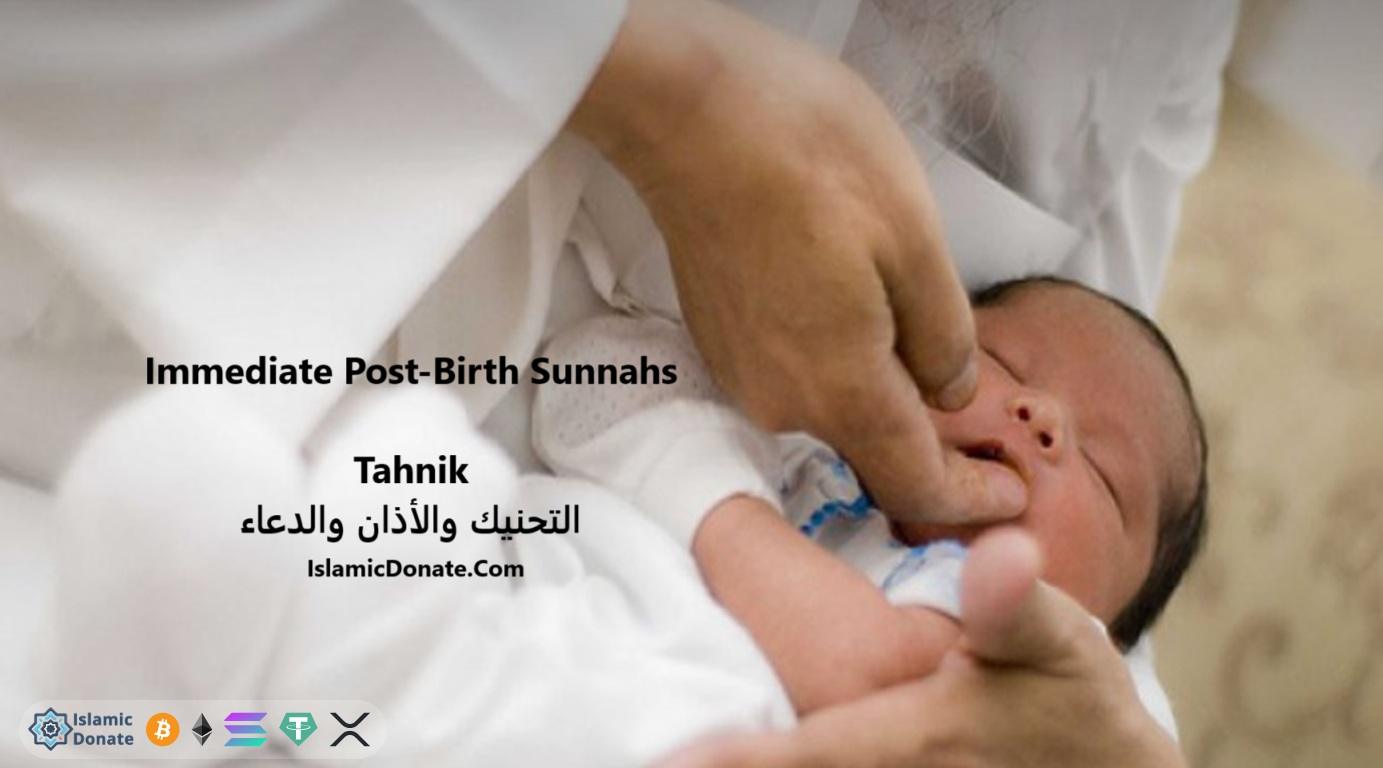
Tahnik is the Prophetic Sunnah of softening a tiny piece of date and gently rubbing a minuscule amount of its sweet pulp onto the newborn’s upper palate or inner cheek shortly after birth, accompanied by supplications for blessing (barakah). In Sahih al-Bukhari (5467) and Sahih Muslim (2145), Asma’ bint Abi Bakr narrated that when she gave birth to Abdullah ibn al-Zubayr at Quba’, she brought him to the Prophet (peace be upon him), who placed the infant in his lap, softened a date, rubbed it on the child’s palate (hannakahu), and prayed for him to be blessed. Similarly, Anas ibn Malik narrated in Sahih Muslim (2144) that he took his newborn brother Abdullah ibn Abi Talhah to the Messenger of Allah (peace be upon him) to perform Tahnik with a date.
Dear parents, please note a crucial point underlying all these hadiths: the date flesh must be soft, meaning it should be completely free of any skin. Furthermore, the infant is not intended to actually consume the date; rather, the taste and sweetness of the date should simply reach the infant’s mouth, allowing the baby to perceive it solely through their tongue.
Parents who perform Tahnik for their child often pair this moment of gratitude with immediate charity; you can give your newborn’s silver hair weight in charity online via Islamic Donate on the very first day or the seventh day to bring spiritual protection to your baby’s life.
Step-by-Step Instructions and Pediatric Safety Protocol for Tahnik
Modern neonatology has uncovered remarkable physiological alignment with the mechanism of Tahnik, provided parents observe strict hygiene and avoid hazardous substitutes. Landmark clinical research (including the Sugar Babies Study published in The Lancet) demonstrated that rubbing a tiny dose of simple sugar gel (dextrose) directly into the buccal mucosa (inner cheek/palate) of newborns effectively prevents and treats neonatal hypoglycemia (low blood sugar) during the critical transition between umbilical cord clamping and the onset of mature maternal milk production, without disrupting breastfeeding.
To carry out Tahnik in complete harmony with both the Sunnah and modern neonatal infectious-disease safety, follow these four rules:
- Never Use Honey for a Newborn Under 12 Months of Age: Classical jurists who lacked microbiological tools occasionally mentioned honey as an alternative when dates were unavailable. Modern pediatrics and infectious disease medicine have established with certainty that raw and pasteurized honey can harbor dormant spores of the bacterium Clostridium botulinum. Because an infant under twelve months has an immature intestinal microbiome with insufficient gastric acidity and protective gut flora, ingested Clostridium botulinum spores germinate inside the baby’s intestines and release botulinum neurotoxin, causing infant botulism (floppiness, respiratory arrest, and potential fatality). Under the Quranic command “And do not throw yourselves into destruction” (Surah Al-Baqarah 2:195) and the Prophetic legal maxim “There shall be no harm and no reciprocating harm” (la darar wa la dirar, Sunan Ibn Majah 2340), using honey for Tahnik is strictly impermissible due to proven medical harm. Always use a clean, soft date (tamr or rutab).
- Eliminate Oral-to-Infant Viral Transmission (HSV-1 Precaution): In the lifetime of the Prophet (peace be upon him), the Companions sought the specific miracle and purity of the Prophet’s own blessed saliva (riq al-nabi), which is unique to him (khasa’is al-nabawiyyah) and cannot be replicated by ordinary people. Today, up to 67 percent of adults carry Human Herpesvirus 1 (HSV-1, the cold sore virus) or periodontal bacteria in their saliva, often shedding the virus asymptomatically. In a newborn with an undeveloped blood-brain barrier, HSV-1 transmission can cause fatal neonatal herpes encephalitis. Therefore, do not have relatives or non-parents chew a date in their mouth and place their saliva into the baby’s mouth. Instead, the mother or father should wash their hands thoroughly with antibacterial soap (or wear a sterile medical glove) and mash the core pulp of a freshly washed, soft Medjool or Ajwa date between two clean spoons with two drops of sterile boiled water or expressed maternal colostrum.
- Use a Minuscule Smear, Not a Solid Piece: A newborn lacks the oral motor coordination to swallow solid food and is at risk of airway aspiration. Take only a microscopic film of the mashed date liquid on the tip of a clean pinky finger and lightly wipe it across the baby’s upper palate or inner cheek membrane.
- Recite the Prophetic Supplication for Blessing (Du’a al-Barakah): As you touch the palate, say:
-
- Arabic: «اللَّهُمَّ بَارِكْ فِيهِ (فِيهَا)، وَاجْعَلْهُ مِنَ الصَّالِحِينَ الْمُفْلِحِينَ»
- Transliteration: “Allahumma barik fihi (or fiha for a girl), waj’alhu min al-salihin al-muflihin”
- Translation: “O Allah, bless him/her, and make him/her among the righteous and successful”
and recite the protection prayer of Ibrahim (peace be upon him) recorded in Sahih al-Bukhari (3371):
-
- Arabic: «أَعُوذُ بِكَلِمَاتِ اللَّهِ التَّامَّةِ مِنْ كُلِّ شَيْطَانٍ وَهَامَّةٍ، وَمِنْ كُلِّ عَيْنٍ لاَمَّةٍ»
- “U’idhuka bi-kalimatillahi al-tammah min kulli shaytanin wa hammah, wa min kulli ‘aynin lammah”
- “I seek refuge for you in the perfect words of Allah from every devil and poisonous creature, and from every envious evil eye”.
What Are the Islamic Rules for Choosing a Newborn Baby Name and When Should a Child Be Named?
Muslim parents are instructed to choose a dignified, meaningful name that honors the child in both this world and the Hereafter, and the Sunnah permits naming the newborn on the first day of birth, the third day, or the seventh day alongside the Aqiqah. Imam Al-Bukhari and Imam Al-Nawawi reconciled the authentic narrations on naming timeframes by explaining that parents who have already selected a name before or at birth may announce it on Day 1 (as the Prophet, peace be upon him, did in Sahih Muslim 2315: “A boy was born to me tonight and I named him after my forefather Ibrahim”), whereas parents who wish to deliberate may announce the name on Day 7 during the Aqiqah ceremony (as narrated in Sunan Abi Dawud 2838: “Every child is pledged to his Aqiqah, which is sacrificed for him on his seventh day, his head is shaved, and he is named”).
When selecting a name and registering the birth, many families establish an ongoing charitable legacy (Sadaqah Jariyah) in their newborn’s name; you can sponsor a clean water well in your baby’s name on Islamic Donate so your child grows up connected to humanitarian service.
The Four Tiers of Permissible Names in Islam
- Names Indicating Servitude to Allah (Al-Ta’bid): Ibn Umar narrated in Sahih Muslim (2132) that the Messenger of Allah (peace be upon him) said: “Indeed, the most beloved of your names to Allah are Abdullah (Servant of Allah) and Abdur-Rahman (Servant of the Most Merciful).” This tier includes any name combining ‘Abd with an authentic Divine Name of Allah, such as Abdul-Aziz, Abdul-Malik, or Abdul-Karim, and for females, names expressing devotion or righteous character.
- Names of the Prophets and Messengers (peace be upon them): Naming boys after the Prophets mentioned in the Quran (such as Muhammad, Ahmad, Ibrahim, Musa, ‘Isa, Yusuf, Nuh, Yahya, and Zakariyya) is unanimously commended by the scholars.
- Names of the Righteous (Al-Salihin) and Companions (Sahabah): Naming boys after the noble Companions and girls after the exemplary women of revelation and Islamic history (such as Maryam, Asiyah, Khadijah, Fatimah, Aisha, Hafsah, Zaynab, Sumayyah, and Umm Salamah) gives the child righteous role models to emulate.
- Culturally Beautiful Names with Virtuous Meanings: Islam does not require a name to be of Arabic origin. Any name in Persian, Turkish, Urdu, English, Malay, or African languages is completely halal and praiseworthy provided its meaning is pure, optimistic, and free from religious violations.
Five Categories of Prohibited (Haram) or Disliked (Makruh) Names
- Servitude to Anyone Other Than Allah (Shirk fi al-Tasmiyah): Ibn Hazm recorded scholarly consensus (ijma’) in Maratib al-Ijma’ that it is strictly haram to name a child ‘Abd (slave/servant) attached to anything other than Allah, such as Abdul-Nabi (slave of the Prophet), Abdul-Ka’bah, Abdul-Husayn, or Abdul-Shams.
- Names Exclusive to Allah’s Lordship or Majesty: Adopting names unique to the Creator (such as Al-Khaliq without ‘Abd, Al-Quddus, or Ar-Rahman) or titles of absolute sovereignty is forbidden. In Sahih al-Bukhari (6205), the Prophet (peace be upon him) stated that the most despised name before Allah on the Day of Resurrection is a man calling himself Malik al-Amlak (King of Kings / Shahanshah), as there is no Sovereign except Allah.
- Names Carrying Ugly, Pessimistic, or Sinful Meanings: The Prophet (peace be upon him) actively changed names that carried harsh or rebellious connotations into gentle, optimistic names. For example, in Sahih Muslim (2139), he changed the name of a woman called ‘Asiyah (Disobedient) to Jamilah (Beautiful), and changed Harb (War) to Silm (Peace).
- Names of Tyrants, Pharaohs, and Devils: Naming a child after enemies of faith (such as Fir’awn, Qarun, Haman, or Iblis) is prohibited.
- Names Implying Self-Purification (Tazkiyah) or Arrogant Claims: In Sahih Muslim (2142), the Prophet changed the name Barrah (Pious/Faultless) to Zaynab so people would not claim self-righteousness or experience negative omens if someone asked, “Is Righteousness inside the house?” and the reply was “No.”
Paternal Lineage (Nasab) Rule
Under Surah Al-Ahzab (33:5), “Call them by the names of their fathers; that is more just in the sight of Allah”, every child must keep their biological father’s family lineage. Even when a family sponsors or cares for an orphaned child (kafalah), the child retains their biological father’s surname rather than taking the adoptive guardian’s paternity.
Which Cultural Newborn Superstitions and Bid’ah Practices Must Muslim Parents Avoid?
Across many regions, local folklore has blended pagan or superstitious rituals into childbirth celebrations. Because protecting a newborn’s creed (‘aqidah) and physical health is an obligation upon parents, every family must distinguish authentic Prophetic guidance from harmful cultural innovations (bid’ah) and minor polytheism (shirk asghar). Instead of spending money on superstitious charms that bring neither benefit nor protection, parents can channel their protective concern into authentic charity such as providing hot cooked meals to hungry orphans through Islamic Donate, fulfilling the Prophetic teaching that charity extinguishes calamity.
“Sadaqah (Charity) extinguishes bad deeds just as water extinguishes fire” (Sunan Ibn Majah 4210)
| Cultural Superstition / Innovation | Why It Violates Shariah (Fiqh / ‘Aqidah) | Modern Medical & Safety Hazard | Authentic Sunnah Replacement |
| Tying Blue Evil-Eye Beads (Nazar), Black Strings, or Amulets (Tama’im) on the Baby | Categorized as prohibited tama’im and minor shirk (Sunan an-Nasa’i 4079: “Whoever hangs an amulet has committed shirk”) | Severe choking, strangulation, and tourniquet syndrome hazard around tiny infant wrists and necks | Recite Surah Al-Falaq, Surah An-Nas, and the Prophetic Ruqyah of Ibrahim (Sahih al-Bukhari 3371) |
| Placing Iron Knives, Scissors, Pins, or a Miniature Quran Under the Baby’s Pillow | Believing iron wards off jinn is a baseless pagan superstition; the Quran was revealed to be recited, not used as a physical pillow charm | Sharp metal objects and pillows in a bassinet create direct puncture hazards and Sudden Infant Death Syndrome (SIDS) suffocation risk | Keep the crib completely bare on a firm mattress (back-to-sleep protocol) and recite Quran aloud in the room |
| Applying Traditional Black Kohl (Surma / Kajal) to the Newborn’s Eyes | No authentic Hadith commands applying kohl to newborns | FDA and pediatric toxicologists warn traditional kohl/surma contains up to 50–80% lead sulfide (PbS), causing irreversible infant lead poisoning, anemia, and brain damage; also causes chemical conjunctivitis | Leave the newborn’s eyes clean; allow only sterile hospital erythromycin ointment if medically indicated |
| Smearing Sacrificial Aqiqah Blood on the Baby’s Forehead | Explicitly abrogated and forbidden by the Prophet (peace be upon him) as a practice of Jahiliyyah (Sunan Abi Dawud 2843) | Exposes the newborn’s fragile skin barrier and fontanelle to raw bloodborne pathogens (Brucella, Salmonella, E. coli) | Apply a gentle touch of baby-safe soothing oil after bathing the scalp |
| Treating the Postpartum Mother (Nufasa’) as “Untouchable” or Spiritually Impure for 40 Days | Postpartum bleeding (nifas) is a ritual state waiving prayer and fasting, not a personal or spiritual contamination (Sahih Muslim 371: “The believer never becomes impure”) | Enforced isolation deepens postpartum depression (PPD) and deprives the mother of sunlight (Vitamin D) and family emotional support | Honor, serve, and comfort the mother while encouraging rest, hydration, and nutrition |
Frequently Asked Questions
1- How should the Adhan be safely recited into a newborn's ear according to Islamic Sunnah?
Islamic jurisprudence recommends softly reciting the Adhan near the newborn's right ear so the declaration of Tawhid is the first sound heard. Medically, parents must hold the infant several inches away and whisper below 50 decibels to protect delicate cochlear hair cells and thin eardrums from acoustic trauma.
2- How do parents safely perform Tahnik for a newborn without medical risks?
Parents should wash their hands thoroughly and mash a tiny piece of skinless date pulp using sterile water or maternal colostrum. Never use honey due to the risk of infant botulism. Apply only a microscopic film to the baby's upper palate or cheek to prevent airway aspiration and viral transmission.
3- Why is honey strictly forbidden when performing Tahnik on an infant?
Honey is strictly impermissible for infants under twelve months because it can contain dormant Clostridium botulinum spores. A baby's immature intestinal system cannot prevent these spores from germinating and producing dangerous botulinum neurotoxins, leading to fatal infant botulism. Islamic legal maxims prohibit any practice that introduces proven bodily harm.
4- What types of baby names are prohibited or disliked under Islamic law?
Islam strictly forbids names indicating servitude to anyone other than Allah, such as Abdul-Nabi, as well as names exclusive to the Creator like Al-Khaliq. Additionally, names of tyrants, devils, and words with ugly, rebellious, or excessively self-praising connotations are prohibited or disliked to protect the child's dignity and creed.