
Understand Aqiqah rules across all four madhhabs, calculate your newborn’s seventh-day silver charity, and learn safe medical steps for shaving their hair.
What Is Aqiqah in Islam and Is It Obligatory or Sunnah for a Newborn Baby?
Aqiqah (also gracefully termed Nasikah by the Prophet, peace be upon him, in Sunan al-Nasa’i 4212) is the sacrificial slaughter of livestock performed in gratitude to Allah for the blessing of a newborn child. In Sahih al-Bukhari (5472), Salman ibn ‘Amir al-Dabbi narrated that the Messenger of Allah (peace be upon him) said: “With the boy there is an Aqiqah, so shed blood on his behalf and remove harm from him.” Furthermore, Samurah ibn Jundub reported in Sunan Abi Dawud (2838) and Sunan al-Tirmidhi (1522) that the Prophet (peace be upon him) said:
“Every child is pledged (murtahan) to his Aqiqah, which is sacrificed on his behalf on his seventh day, his head is shaved, and he is given a name.”
Classical commentators, including Imam Ahmad ibn Hanbal and Ibn al-Qayyim in Tuhfat al-Mawdud bi-Ahkam al-Mawlud, explained that the phrase “pledged to his Aqiqah” means the child’s natural spiritual wellbeing, safety from Satan’s interference, or future intercession for his parents is unlocked through performing this prophetic sacrifice.
Comparison of the Four Sunni Schools of Jurisprudence on Aqiqah
| School of Jurisprudence (Madhhab) | Legal Ruling on Aqiqah (Hukm) | Recommended Number of Sheep/Goats | Ruling if Only 1 Sheep Is Sacrificed for a Boy |
| Shafi’i School | Sunnah Mu’akkadah (Confirmed Sunnah) for a financially able father | 2 sheep for a boy; 1 sheep for a girl | The basic Sunnah is fulfilled with 1 sheep, though 2 is complete perfection |
| Hanbali School | Sunnah Mu’akkadah (encouraged even to borrow if one has guaranteed repayment means) | 2 sheep for a boy; 1 sheep for a girl | Permissible and valid with 1 sheep if financial capacity is limited |
| Maliki School | Mandub / Sunnah (Recommended) | 1 sheep for a boy; 1 sheep for a girl (based on Ibn ‘Abbas report) | Complete fulfillment of the Sunnah in the Maliki view |
| Hanafi School | Mubah / Tatawwu’ (Permissible voluntary act of gratitude) | 2 sheep for a boy; 1 sheep for a girl | Valid voluntary charity and thanksgiving |
This scholarly comparison highlights an essential relief for parents facing economic hardship: while the primary recommendation in the Hadith of Umm Kurz (Sunan Abi Dawud 2834; Jami` at-Tirmidhi 1513) is two comparable sheep for a boy and one sheep for a girl, Ibn ‘Abbas narrated in Sunan Abi Dawud (2841) that the Messenger of Allah (peace be upon him) sacrificed one ram each for his grandsons Al-Hasan and Al-Husayn. Therefore, if a family can only afford one sheep for a newborn son, the Aqiqah is valid and accepted according to the majority of scholars.
Calculating the Exact Seventh Day in the Islamic Calendar
In Islamic jurisprudence (Fiqh), the day of birth is counted as Day 1 provided the baby was born before sunset (Maghrib). If the baby was born after Maghrib (since the Islamic date advances at sunset), the following daytime counts as Day 1. In fiqh, certain rituals such as tahnik are recommended for the very first day of a child’s life; you may perform these for your newborn, accompanied by the specific prayers associated with them.
- Practical Rule of Thumb: A baby born during the daytime on a Monday has their seventh day on the following Sunday (Monday = 1, Tuesday = 2, Wednesday = 3, Thursday = 4, Friday = 5, Saturday = 6, Sunday = 7).
- If the 7th Day Is Missed: If medical complications, NICU admission, or temporary financial strain delay the sacrifice beyond the seventh day, the classical jurists advise performing it on the 14th day or the 21st day, and if those pass, on any subsequent day. Furthermore, if parents never performed Aqiqah for a child, Imam Al-Shafi’i and contemporary scholars permit an adult Muslim to perform their own Aqiqah later in life, drawing on the report recorded by Al-Bayhaqi regarding the Prophet’s sacrifice after prophethood.
What Are the Shariah Conditions for the Aqiqah Animal and How Should the Meat Be Distributed?
According to the majority of scholars (Maliki, Shafi’i, and Hanbali), the sacrificial animal for Aqiqah must meet the exact same veterinary and Shariah soundness conditions required for the Udhiyah (Eid al-Adha sacrifice):
- Minimum Age (Al-Sinn al-Mu’tabar): Based on the Hadith of Jabir in Sahih Muslim (1963), a sheep (da’n) must be at least six months old (jadha’), a goat (ma’z) must be at least one full lunar year old (thaniyy), cattle must be two years old, and camels five years old. Sacrificing sheep or goats individually is preferred by the scholars over sharing a seventh of a cow or camel for Aqiqah, because the Prophetic practice was to shed an independent life (dam mustaqill) for the newborn.
- Freedom from Disqualifying Defects (Al-‘Uyub): As established in the Hadith of Al-Bara’ ibn ‘Azib in Sunan Abi Dawud (2802), the animal must be free of four disqualifying defects: obvious blindness in one or both eyes (al-‘awra’ al-bayyin ‘awaruha), obvious sickness or infection (al-maridah), obvious lameness preventing it from walking with the flock (al-‘arja’), and severe emaciation lacking bone marrow (al-‘ajfa’ / al-kasir).
- Etiquette of Butchering (Joint Separation vs. Bone Breaking): It is a commendable courtesy reported from Aisha (may Allah be pleased with her) and the Tabi’in (Muwatta Malik, Musannaf Abd al-Razzaq) for the butcher to cut the Aqiqah meat at the anatomical joints rather than smashing the bones, as an optimistic wish (tafa’ul) for the soundness and strength of the newborn’s limbs. However, if a bone is broken during cooking or cutting, all four schools agree that the Aqiqah remains 100 percent valid without any sin.
- Distribution and Cooking Options: Unlike emergency expiation sacrifices (kaffarat) where the family cannot eat any portion, the parents and household are encouraged to eat from the Aqiqah, gift a portion to relatives and neighbors, and donate a generous share to the poor. Alternatively, parents may donate 100 percent of the Aqiqah meat to impoverished and displaced families in famine or conflict zones, which multiplies the reward by combining the Sunnah of Aqiqah with life-saving feeding of the destitute (it’am al-miskin).
How Do You Shave a Newborn’s Head on the Seventh Day and Calculate the Silver Charity?
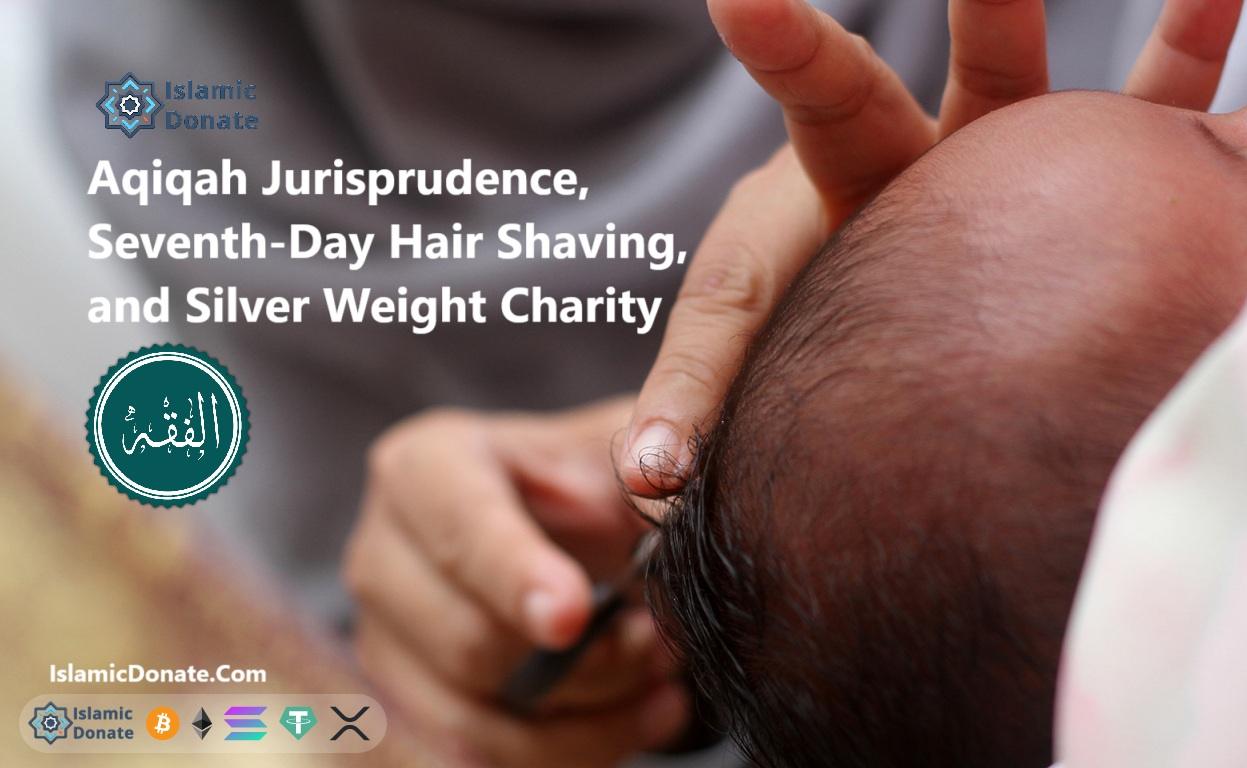
On the seventh day after birth, after the Aqiqah sacrifice is offered, it is a confirmed Sunnah to shave the newborn’s prenatal hair (al-‘aqiqah) and give the equivalent weight of that hair in pure silver (or its monetary cash value) as charity (Sadaqah) to the poor. In Sunan al-Tirmidhi (1519), Ali ibn Abi Talib (may Allah be pleased with him) narrated that the Messenger of Allah (peace be upon him) sacrificed a sheep for Al-Hasan and said:
“O Fatimah, shave his head and give the weight of his hair in silver as charity. So she weighed it, and its weight was equivalent to a dirham or part of a dirham.”
- Shave the Entire Scalp Uniformly on Day 7: Avoid prohibited partial shaving (Al-Qaza’). In Sahih al-Bukhari (5920) and Sahih Muslim (2120), Ibn Umar narrated that the Messenger of Allah (peace be upon him) forbade Al-Qaza’ (shaving part of the child’s head while leaving tufts or patches unshaved) and commanded: “Shave all of it, or leave all of it.” Whether a boy or a girl is shaved (the Maliki, Shafi’i, and Hanbali schools extend the seventh-day shaving and silver charity to newborn girls as well, citing the narration in Muwatta Malik where Fatimah weighed the hair of Al-Hasan, Al-Husayn, Zaynab, and Umm Kulthum), the shave must be complete and gentle.
- Weigh the Shaved Hair or Apply the Conservative Weight Benchmark: Use a digital jewelry scale or the safe estimation method. Place a clean piece of paper on a precision digital gram scale, tare the scale to 0.00 grams, and place the dry shaved newborn hair onto the scale. A full head of newborn hair typically weighs between 1.5 grams and 3.0 grams. If the baby was born bald, or if medical precautions (such as NICU care or scalp bruising) prevent physical shaving on Day 7, the scholars state that the parents should still calculate and donate the silver charity based on an estimated weight of 3 to 5 grams of pure silver.
- Calculate the Monetary Value of the Silver Charity: Benchmark against 99.9% fine silver spot price. Multiply the weight of the hair (in grams) by the current spot price per gram of 99.9% pure silver. Because 2 to 3 grams of pure silver typically equals only a few dollars in raw melt value, scholars strongly encourage parents to treat the silver weight as the minimum baseline and add voluntary thanksgiving charity (Sadaqah al-Shukr) according to their financial capacity so a poor family can purchase a complete meal or baby formula.
- Disburse the Silver Charity to the Poor (Fuqara’ and Masakin): Distribute immediately to eligible needy recipients. Send the calculated silver sadaqah directly to verified impoverished recipients or through an accountable Islamic humanitarian institution on Day 7 so the spiritual blessing accompanies the infant immediately.
Worked Silver Charity Calculation Table (2026 Benchmarks)
We provide a detailed calculation table; however, since the price of silver fluctuates in real time, please use the online calculator to determine the amount of silver required for a newborn’s sadaqah.
| Newborn Hair Scenario | Hair Weight Used for Calculation | Minimum Pure Silver Equivalent | Recommended Charitable Rounding for Maximum Barakah |
| Light or Fine Newborn Hair (or Bald Neonate) | 2.0 grams (Conservative estimate) | Value of 2.0g fine silver (99.9% Ag) | Round up to cover 1–2 hot nutritious meals for an orphan |
| Average Full Head of Newborn Hair | 3.0 grams | Value of 3.0g fine silver (99.9% Ag) | Round up to fund infant formula or infant hygiene packs |
| Thick Newborn Hair (or Twins Combined) | 5.0 to 6.0 grams | Value of 5.0–6.0g fine silver (99.9% Ag) | Round up to sponsor a full neonatal nutrition parcel |
What Medical Precautions Should Parents Take When Shaving a Newborn Baby’s Scalp?
A seven-day-old infant has unique cranial anatomy and skin physiology that require careful medical precautions before touching any grooming instrument to the scalp:
- Protecting the Anterior and Posterior Fontanelles (“Soft Spots”): A newborn’s skull bones are separated by fibrous sutures and two major membrane-covered openings: the diamond-shaped anterior fontanelle at the top front of the head and the triangular posterior fontanelle at the back. These allow the brain to grow rapidly during the first year. Never press down on the fontanelles, and never scrape a hard edge across the suture ridges.
- Preventing Neonatal Folliculitis and Cellulitis: The outer layer of a newborn’s skin (stratum corneum) is 30 percent thinner than adult skin, and the baby’s cellular immune system is still maturing. Using an exposed disposable razor blade creates microscopic epidermal cuts (micro-lacerations) that allow skin bacteria such as Staphylococcus aureus or Group B Streptococcus to enter the hair follicles, risking neonatal scalp cellulitis or systemic infection. Medical Recommendation: Instead of an exposed wet razor blade, use a sterilized, whisper-quiet pediatric electric trimmer with a rounded ceramic safety guard, or ask an experienced handler to trim the hair flush against the scalp without scraping the epidermis.
- When to Delay Physical Shaving (Medical Exemptions): Under the Islamic legal maxim “Hardship brings ease” (al-mashaqqa tajlib al-taysir), parents must delay physical shaving while still paying the silver charity on Day 7 if the baby has any of the following conditions:
- Cephalohematoma or Caput Succedaneum: Localized scalp swelling or subperiosteal blood collection caused by vacuum extraction or birth canal pressure during delivery.
- Scalp Electrode Monitoring Sites or IV Lines: Any healing puncture site on the scalp from fetal monitoring or NICU intravenous access.
- Prematurity or Incubator Care: Premature infants rely on every bit of thermal insulation to maintain core body temperature and have extremely fragile skin.
- Severe Infantile Seborrheic Dermatitis (Inflamed Cradle Cap) or Neonatal Eczema: Wait until the skin barrier is intact and cleared by your pediatrician.
Frequently Asked Questions
1- How is the seventh day calculated for a newborn's Aqiqah?
In Islamic jurisprudence, birth counts as Day 1 if born before sunset (Maghrib); otherwise, the following day begins the count. For daytime Monday births, Day 7 falls on Sunday. If missed due to medical or financial constraints, classical scholars recommend performing it on the 14th, 21st, or any subsequent day.
2- What Shariah conditions must an Aqiqah animal fulfill?
The animal must meet Udhiyah criteria: sheep must be at least six months old and goats at least one lunar year. Additionally, it must be completely free from four disqualifying physical defects: obvious blindness, evident illness, noticeable lameness that hinders walking with the herd, and severe emaciation lacking bone marrow.
3- How is the silver charity for a newborn calculated?
Parents weigh the shaved hair on a digital scale (usually 1.5 to 3 grams) and multiply that weight by the current spot price of pure silver. If the baby is bald or medical reasons delay shaving, parents donate an estimated value of 3 to 5 grams of silver directly to the poor.
4- What safety precautions should parents observe when shaving a newborn's head?
Never apply downward pressure over the delicate anterior and posterior fontanelles. Avoid exposed razor blades, which cause micro-cuts and bacterial infections like cellulitis, by using a sterilized safety trimmer instead. Furthermore, immediately postpone physical shaving if the infant is premature or presents with birth swelling, scalp wounds, or severe cradle cap.