


Understanding Haram Wealth: Islamic Guidelines
In our journey as Muslims striving to adhere to Islamic principles, questions often arise about the permissibility of certain actions, especially concerning financial matters. One such question is: Can haram (forbidden) money be given to charity? Let’s explore this topic together to understand the guidance provided by Sharia law.
Haram wealth refers to earnings acquired through means explicitly prohibited in Islam. This includes income from activities such as selling alcohol, gambling, dealing with interest (riba), or any form of dishonesty and exploitation. As Muslims, we are encouraged to seek halal (lawful) sustenance and avoid haram sources of income.
You Cannot Spend Forbidden Money: Guidance from the Quran and Hadith
It’s essential to recognize that zakat, kaffarah, and other forms of Sharia obligations giving are acts of worship intended to purify our wealth and souls. However, using haram money for these purposes contradicts the very essence of purification. Ultimately, it means that paying Sharia obligations(Wajib) through haram money is not permissible.
The Prophet Muhammad (peace be upon him) emphasized that Allah is pure and accepts only that which is pure. Therefore, attempting to fulfill our religious obligations with impure earnings is not acceptable in Islam.
“O you who have believed, spend from the good things which you have earned and from that which We have produced for you from the earth. And do not aim toward the defective therefrom, spending [from that] while you would not take it [yourself] except with closed eyes. And know that Allah is Free of need and Praiseworthy.” Surah Al-Baqarah (2:267)
Islamic teachings provide clear directives on handling haram wealth:
Quranic Guidance: Allah commands us not to consume one another’s wealth unjustly. This directive underscores the importance of ensuring our earnings are lawful and just.
Prophetic Teachings: The Prophet Muhammad (peace be upon him) highlighted the significance of halal earnings, stating that Allah does not accept zakat from haram sources. This hadith serves as a stern reminder that the purity of our income directly impacts the acceptance of our charitable deeds.
In Islamic jurisprudence, haram money cannot be used for your own benefit or that of your family, nor can it be given as Zakat with the expectation of spiritual reward. Instead, it must be disposed of by giving it to a charitable cause to benefit the public or those in need. By transferring these funds to Islamic Donate Charity, you fulfill the requirement to cleanse your holdings while providing essential aid to vulnerable communities.
Scenarios Involving Haram Money: Examples for Better Understanding
Life can present complex situations where one might come into possession of haram money. Let’s consider some scenarios and the appropriate Islamic responses:
- Earnings from Prohibited Businesses: If you’ve earned money through selling prohibited items or services, it’s imperative to cease such activities immediately. The wealth accumulated from these ventures should be disposed of by giving it away without the intention of seeking reward, as it’s not considered rightful earnings.
- Interest (Riba) Accumulation: Money gained from interest should not be utilized for personal benefit. Instead, it should be disposed of in a manner that does not perpetuate the sin, such as donating it without the intention of reward.
- Inheritance of Haram Wealth: If you inherit wealth that includes haram earnings, it’s crucial to separate the lawful from the unlawful. The haram portion should be disposed of appropriately, ensuring that your own wealth remains pure.
Disposing of Haram Wealth: The Correct Course of Action
When faced with haram money, the primary objective is to cleanse oneself from its impurity. The recommended course of action includes:
- Returning to the Rightful Owner: If the source from whom the money was wrongfully taken is known, efforts should be made to return it.
- Disposing Through Charity: If returning the money isn’t feasible, it should be given away in charity, not with the intention of earning reward, but as a means of purifying one’s remaining wealth.
While returning illicit funds to a rightful owner is possible in the physical world, the digital landscape presents unique challenges. In the realm of cryptocurrency, the high velocity of transactions often obscures the trail of assets. Because identifying the original owner is frequently impossible in these virtual environments, it is necessary to develop alternative strategies for restitution or asset recovery.
Is Investing in Cryptocurrency Halal?
Yes, investing in cryptocurrency can be halal but only if you choose digital assets that comply with Islamic principles. In Islam, financial transactions must be free from riba (interest), gharar (excessive uncertainty), and haram activities.
At Islamic Donate Charity, we only accept Sharia-compliant cryptocurrencies, carefully reviewed by Islamic scholars and imams. The digital currencies we use for donations and charity projects meet Islamic financial guidelines and are considered halal for investment and transactions. Click here to see the list of halal cryptocurrencies we accept for donations!
Purifying Your Crypto Assets from Haram Earnings
It is possible to inadvertently acquire haram wealth through activities like “pump and dump” schemes or high-risk meme coins without realizing their impermissibility at the time. Once you recognize that a portion of your wealth has come from a haram source, you must take steps to remove it from your personal assets to ensure your remaining wealth is halal and purified.
For whatever reason, you have haram money. The question is:
- Can I convert haram money into halal money? Yes.
- How can I make my haram money halal? You should give the amount that is haram as Sadaqah(charity) and the rest of your money will become halal. Click to give Sadaqah or for more information about Sadaqah.
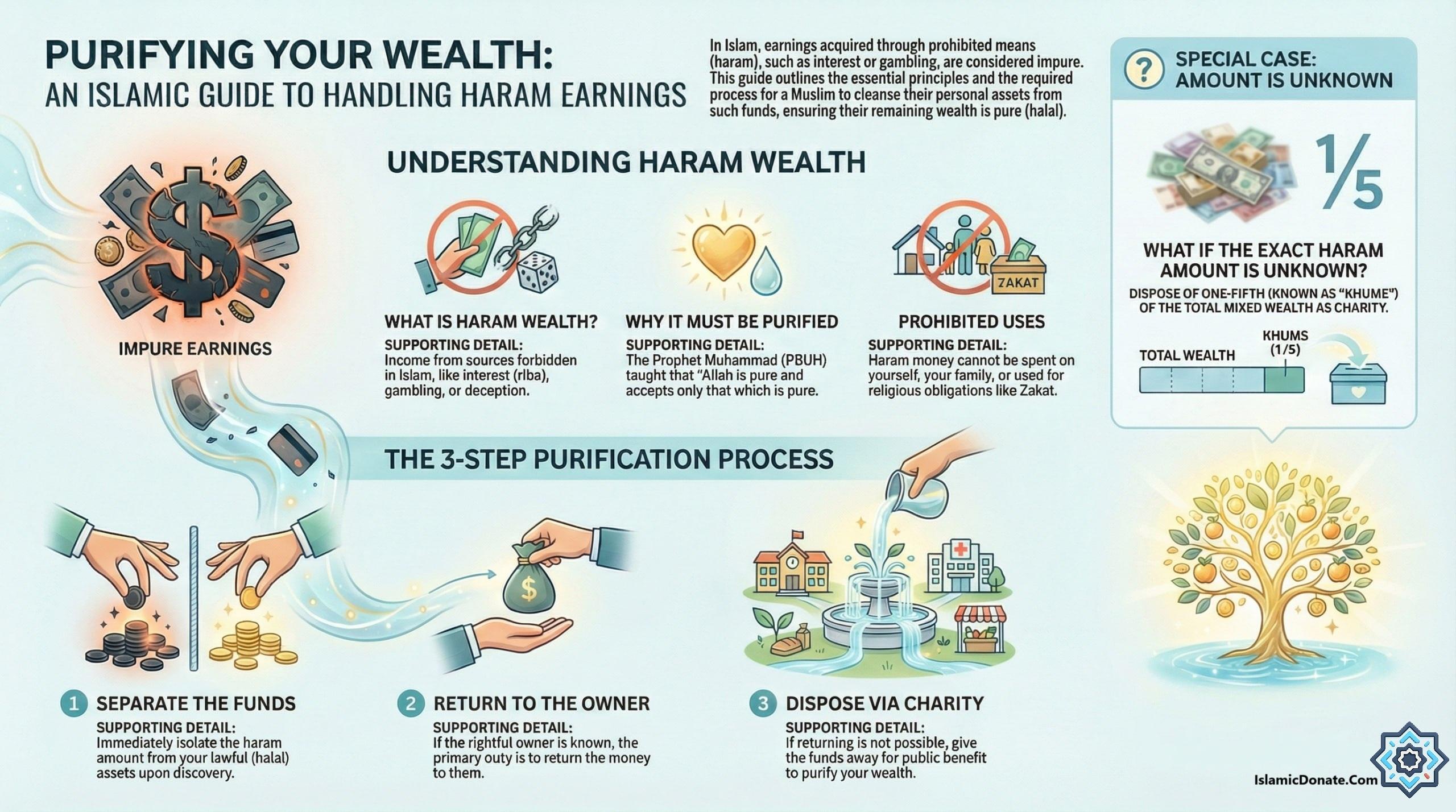
- I don’t know exactly how much of my money is haram? You should give the amount of khums of your entire money to Sadaqah. (Definition of Khums: One-fifth of the total wealth that is mixed with haram)
Stages of Purifying Haram Wealth
- Understanding Forbidden Earnings Haram money includes any income from prohibited sources such as interest (riba), gambling, or deceptive crypto schemes like pump and dumps. As Muslims, we must avoid these sources and seek only halal sustenance to ensure our wealth remains blessed.
- Restricting Personal Use Islamic law prohibits spending haram earnings on yourself, your family, or your personal needs. This money carries no barakah and cannot be used for any personal benefit. It must be separated from your halal assets immediately upon discovery.
- Disposal via Public Benefit You cannot use haram funds to fulfill sacred obligations like Zakat or Kaffarah because Allah only accepts what is pure. Instead, you must dispose of these funds by giving them to charity. While you do not earn the spiritual reward of Sadaqah, you fulfill the duty of cleansing your wealth.
- Completing the Purification By transferring these funds to Islamic Donate Charity, you ensure they are used for the public good, such as providing clean water or emergency shelter. This process removes the prohibited burden from your account and restores the halal status of your remaining assets.
Have you come to realize that some of your wealth may not be lawful and now your heart seeks purification, but your reputation holds you back? We understand and you’re not alone. Many sincere souls feel the same burden.
Remember, Allah is the Concealer of faults and the Turner of hearts. He says in the Qur’an:
“If you disclose your charities, it is well; but if you conceal them and give them to the poor, it is better for you, and He will remove from you some of your misdeeds. And Allah is All-Aware of what you do.” (Surah Al-Baqarah 2:271)
That’s why we offer anonymous donations so you can purify your wealth quietly, without fear or shame. It stays between you and Allah alone.
Anonymous Donation
Take that step. Cleanse your heart. Let your giving be your path back to peace.
As Muslims, we understand the importance of upholding the principles of Sharia in all aspects of our lives, including our financial dealings. While the temptation might exist to use haram money for charitable purposes, Islamic teachings guide us to maintain the purity of our wealth by disposing of such earnings appropriately. By adhering to these principles, we not only purify our own wealth but also ensure that our charitable actions are accepted and pleasing to Allah.
Let’s continue to support each other in seeking halal sustenance and engaging in charitable acts that truly reflect the purity and integrity of our faith.