


The Fiqh of Giving: The Effect of Intention on Giving
Understanding the subtle distinctions between Infaq, Sadaqah, and Hibah is essential for Muslims navigating Islamic charity rules and halal wealth distribution. While these terms generally relate to the transfer of wealth, Islamic jurisprudence establishes precise boundaries for each based on intention, obligation, and the target recipient. Clarifying these concepts helps individuals align their financial practices with Islamic finance principles.
Infaq (Islamic Spending)
Infaq is the broadest and most encompassing term.Linguistically meaning to disburse, Infaq in Islam covers any expenditure made to seek the pleasure of Allah. Linguistically derived from the root N-F-Q, it means “to spend” or “to disburse.” This category includes both mandatory financial duties and voluntary acts of generosity. For example, providing financial support for one’s family, funding community infrastructure, or paying legitimate business expenses are all considered forms of Infaq. The core requirement in the Fiqh of giving is that the wealth is spent for a lawful and beneficial purpose. Infaq acts as the umbrella term for most financial outflows directed toward good causes, regardless of the recipient’s financial status.
Scope: It includes both obligatory (Wajib) and voluntary (Mandub or Nafilah) spending. Crucially, providing financial support for one’s family (Nafaqah), paying for legitimate business expenses, or funding public infrastructure are all considered forms of Infaq if the intention is pure.
Sadaqah (Voluntary Charity)
Sadaqah is a specific subset of Infaq driven entirely by the intention to secure a spiritual reward in the Hereafter. When analyzing Zakat vs Sadaqah, Zakat operates as a mandatory wealth tax with strict mathematical thresholds (Nisab), whereas Sadaqah generally refers to highly encouraged voluntary charity. Sadaqah serves as a proof of sincere faith and is traditionally directed toward the poor, the needy, or public welfare initiatives.
The scope of Sadaqah extends well beyond financial contributions. Acts of kindness, sharing beneficial knowledge, or removing obstacles from a path are legally recognized as non-material Sadaqah. Furthermore, Sadaqah Jariyah represents a continuous charity, such as building a water well or funding an educational facility, which provides ongoing spiritual rewards even after the donor passes away. The defining pillar of this category in Islamic jurisprudence is the strict spiritual motivation behind the act.
Scope: Primarily voluntary, It is typically directed toward the poor, the needy, or causes that serve the public good. The defining pillar of Sadaqah is the strict intention (Niyyah) of seeking a spiritual reward (Thawab) from Allah in the Hereafter.
Hibah (The Gift)
Hibah translates to a pure gift and falls strictly under Islamic commercial law (Fiqh al-Mu’amalat). Hibah is defined as the immediate and unconditional transfer of asset ownership to another person without any expectation of material compensation (Iwad). Unlike Sadaqah, which prioritizes divine reward and assisting the destitute, Hibah is primarily motivated by worldly affection, honoring relationships, and strengthening bonds of kinship.
A crucial difference lies in the contractual nature of Hibah. Islamic finance principles require a formal process for a Hibah to be legally binding. It necessitates a clear offer, a formal acceptance, and the actual taking of possession. The recipient can be anyone, wealthy or poor, Muslim or non-Muslim. Transferring wealth to a financially stable friend to show appreciation is classified as Hibah, not Sadaqah.
Scope: Purely voluntary, Hibah can be given to anyone, rich or poor, Muslim or non-Muslim. Giving a gift to a wealthy friend is Hibah, whereas giving money to a destitute stranger is Sadaqah.
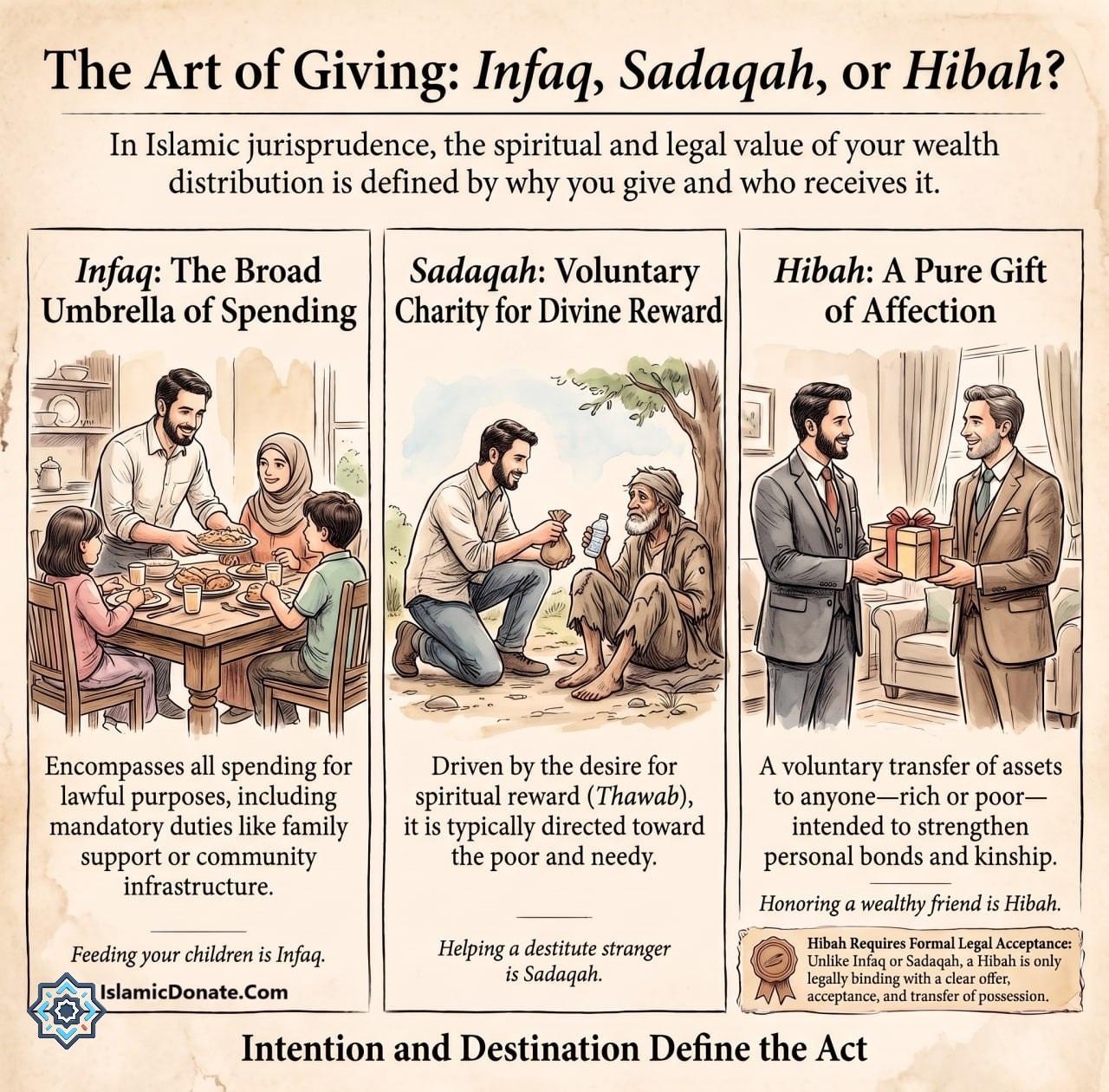
Comparative Jurisprudential Summary
The fundamental differences between these three concepts hinge on the donor’s intention and the recipient’s status.
- Motivation: Infaq is driven by duty or general goodness. Sadaqah is driven by the desire for divine reward. Hibah is driven by love and relationship building.
- Obligation Level: Infaq can be obligatory or voluntary depending on the context. Sadaqah is primarily voluntary. Hibah is always voluntary.
- Target Recipient: Infaq applies to anyone, including immediate dependents. Sadaqah targets the needy and vulnerable. Hibah targets anyone, regardless of their financial standing.
- Formal Requirements: Hibah strictly requires formal offer, acceptance, and physical or constructive possession to be legally valid. Infaq and Sadaqah do not universally require these rigid contractual conditions.
| Feature | Infaq (Spending) | Sadaqah (Charity) | Hibah (Gift) |
| Primary Motivation | Fulfilling a duty or doing good | Seeking Divine reward (Thawab) | Affection, love, strengthening bonds |
| Obligation Level | Can be Obligatory or Voluntary | Primarily Voluntary | Always Voluntary |
| Target Recipient | Anyone (Family, poor, public) | Generally the poor or needy | Anyone (Rich or poor) |
| Form of Wealth | Material wealth | Material or immaterial (actions) | Material wealth / Tangible assets |
| Formal Acceptance | Not always required | Not strictly required in all schools | Strictly required (Ijab & Qabul) |
In deep jurisprudential thought, the difference hinges entirely on intention and destination. If you transfer wealth to a wealthy associate simply to honor them, it is Hibah. If you give that same wealth to a destitute individual to seek God’s favor, it is Sadaqah. If you spend it to feed your own children as a dutiful provider, it is Infaq. By applying these principles, individuals can ensure their charitable efforts and wealth distribution align correctly with established Islamic jurisprudence.