


Master your daily Ramadan routine with authentic Suhoor and Iftar Duas, Fiqh rulings on moon sighting, and 100% direct charity strategies.
What is the spiritual significance of fasting in Ramadan?
Fasting during the ninth month of the Islamic lunar calendar is the fourth pillar of Islam and a direct command from Allah in Surah Al-Baqarah (2:183), prescribed so that believers may attain Taqwa (God-consciousness). While every righteous deed performed by the son of Adam is multiplied between ten and seven hundred times, fasting holds a unique rank in divine accounting. In a Hadith Qudsi recorded in Sahih al-Bukhari (1904) and Sahih Muslim (1151), Allah declares that fasting belongs exclusively to Him, and He alone grants its reward without measure.
“O believers! Fasting is prescribed for you as it was for those before you, so perhaps you will become mindful of Allah.” (Quran 2:183)
Fasting detaches the soul from physical appetites from true dawn (Fajr) until sunset (Maghrib). This physical discipline reaches its highest spiritual potential when paired with continuous generosity. Ibn Abbas (may Allah be pleased with him) reported in Sahih al-Bukhari (6) that the Prophet Muhammad (peace be upon him) was the most generous of all people, and his generosity peaked during Ramadan when the Angel Jibril met him every night to review the Quran.
At Islamic Donate, our field teams witness how your spiritual discipline translates into survival for vulnerable families. When you donate Ramadan food packs to families in crisis or dates and water are being distributed in the camps in Gaza, you follow that prophetic standard directly. Because we operate on a strict 100 percent direct-to-cause policy established in 2018, our volunteers personally pay for all administrative, office, and advertising expenses. Every Bitcoin (BTC) or digital asset you send through our non-custodial cryptocurrency donation gateway goes straight to local procurement on the ground.
How does the month of Ramadan officially begin and end in Islamic jurisprudence?
Entering and exiting the sacred month requires following clear juridical criteria established by the Sunnah. The Prophet (peace be upon him) instructed believers in Sahih al-Bukhari (1909) to begin fasting upon sighting the new crescent moon (Hilal) and to cease fasting upon sighting the crescent of Shawwal. If clouds or atmospheric dust obscure the horizon on the 29th night of Sha’ban, Muslims must complete thirty full days of Sha’ban before starting the Ramadan fast.
Classical and contemporary scholars across the four Sunni schools of jurisprudence (Madhhabs) recognize two primary methods for confirming the crescent:
- Direct ocular sighting: Testimony from one upright, trustworthy Muslim (‘Adl) suffices to establish the start of Ramadan according to the Hanafi, Shafi’i, and Hanbali schools, while the Maliki school requires two trustworthy witnesses or a large group whose agreement on a falsehood is impossible.
- Completing thirty days: If no verified sighting occurs after sunset on the 29th day, the current lunar month automatically extends to thirty days. Fasting on the “Day of Doubt” (Yawm al-Shakk, the 30th of Sha’ban when visibility was blocked) is prohibited in authentic Hadith.
Ending Ramadan and confirming Eid al-Fitr requires a stricter evidentiary standard across all four schools: at least two trustworthy male witnesses must testify before the judicial authority that they sighted the Shawwal crescent.
| Juridical School | Witnesses for Ramadan Start | Witnesses for Ramadan End | Ruling on Cloud Cover |
| Hanafi | 1 trustworthy Muslim (clear sky) | 2 trustworthy witnesses | Complete 30 days of Sha’ban |
| Maliki | 2 trustworthy men | 2 trustworthy men | Complete 30 days of Sha’ban |
| Shafi’i | 1 trustworthy Muslim | 2 trustworthy men | Complete 30 days of Sha’ban |
| Hanbali | 1 trustworthy Muslim | 2 trustworthy men | Complete 30 days of Sha’ban |
Table explanation: Comparison of evidentiary requirements across the four Sunni schools of jurisprudence for confirming the lunar crescents of Ramadan and Shawwal.
Once the crescent is confirmed, fasting becomes obligatory (Fard) upon every Muslim who is sanity-bound (Aqil), past the age of puberty (Baligh), physically capable (Qadir), resident (Muqim, meaning non-traveling), and free from physical impediments such as menstruation (Hayd) or postnatal bleeding (Nifas). To prepare your finances before the first fast begins, review our complete guide to calculating Ramadan Zakat or set up an automated daily Sadaqah transfer for Ramadan.
What are the essential pillars of a valid fast?
A valid daily fast rests upon two foundational pillars (Arkan):
- Al-Niyyah (The intention): The Prophet (peace be upon him) stated in Sunan an-Nasa’i (2331) that whoever does not resolve to fast before Fajr has no valid fast. For obligatory Ramadan fasts, you must form the intention in your heart during the night, anytime between sunset and the break of true dawn. Speaking the intention aloud is an innovation (Bid’ah); the internal resolve of the heart suffices, and waking up for Suhoor naturally counts as a valid intention. While the Shafi’i, Hanbali, and Hanafi schools require renewing this intention every night of Ramadan, the Maliki school permits a single overarching intention on the first night to cover the entire uninterrupted month.
- Al-Imsak (Abstaining from invalidators): You must completely abstain from food, drink, marital relations, and all other fast-invalidating acts from the appearance of the true dawn (Al-Fajr Al-Sadiq, when horizontal whiteness spreads across the horizon) until the sun disk completely disappears below the western horizon at Maghrib.
What should you do before and after Suhoor to earn extra rewards?
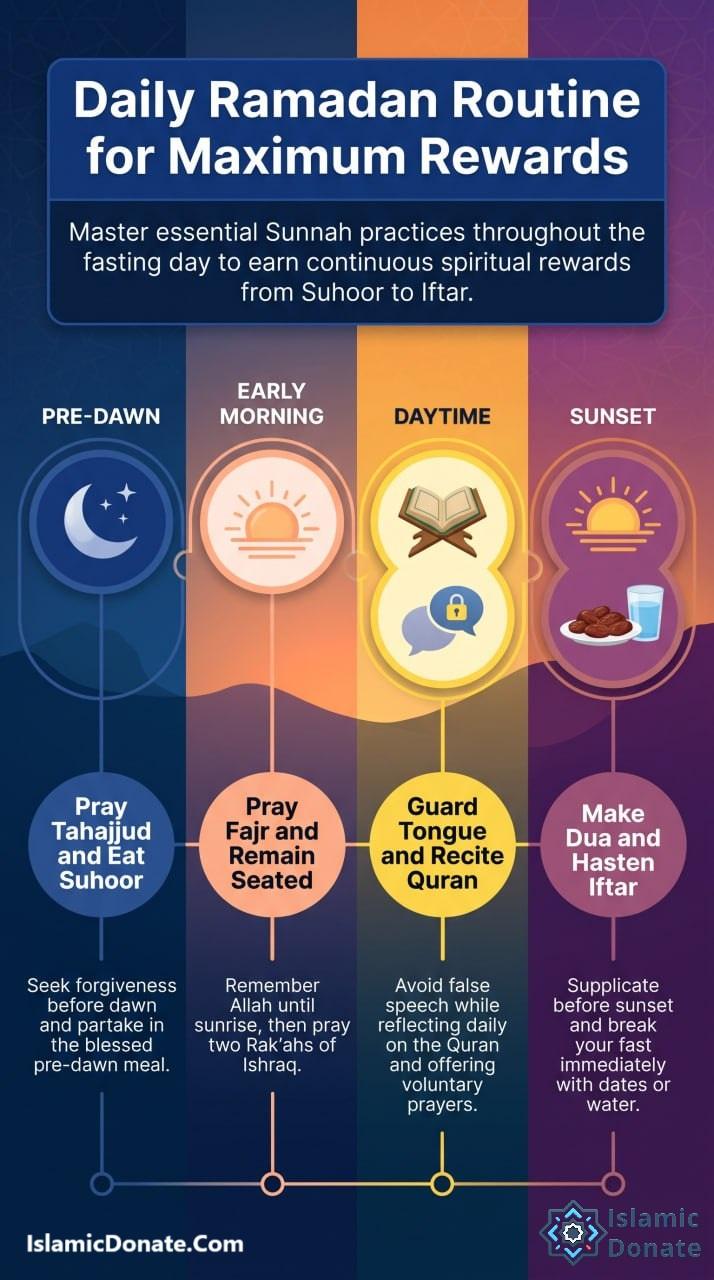
The pre-dawn window (Sahar) is the most spiritually lucrative period of the twenty-four-hour cycle. Structuring your morning around five prophetic habits multiplies your daily ledger of good deeds:
- Pray Tahajjud in the final third of the night: Allah descends to the lowest heaven during the last third of every night, asking who is calling upon Him so He may answer, and who is seeking forgiveness so He may forgive (Sahih al-Bukhari 1145). Praying even two or four light Rak’ahs before eating Suhoor places you among the elite night worshippers.
- Partake in the blessed Suhoor meal: Never skip the pre-dawn meal, even if you only take a few sips of water. Anas ibn Malik (may Allah be pleased with him) narrated in Sahih al-Bukhari (1923) that the Prophet (peace be upon him) commanded eating Suhoor because there is immense Barakah (divine blessing) placed within it. In Sahih Ibn Hibban (3467), the Prophet explained that Allah and His angels send special blessings upon those who eat Suhoor.
- Delay Suhoor until close to Fajr: It is a confirmed Sunnah (Mustahab) to delay the pre-dawn meal until shortly before the Fajr call to prayer. Zayd ibn Thabit (may Allah be pleased with him) reported in Sahih al-Bukhari (1921) that the interval between completing their Suhoor with the Prophet and standing for the Fajr prayer equaled the time required to recite fifty verses of the Quran (approximately fifteen to twenty minutes).
- Conclude Suhoor with Istighfar (seeking forgiveness): In Surah Al-Imran (3:17) and Surah Adh-Dhariyat (51:18), Allah specifically praises the righteous who seek forgiveness in the moments just before dawn (Wal-mustaghfirina bil-ashar). Repeat Astaghfirullah wa atubu ilayh (I seek the forgiveness of Allah and repent to Him) and Sayyid al-Istighfar while waiting for the Fajr Adhan.
- Perform Fajr in congregation and remain seated until sunrise: After praying the two Sunnah Rak’ahs of Fajr (which are better than the world and everything in it, per Sahih Muslim 725) and the obligatory Fajr prayer in congregation, remain in your place of worship remembering Allah until the sun rises completely (about fifteen to twenty minutes after sunrise), then pray two Rak’ahs of Salatul Ishraq (early Duha). In Jami` at-Tirmidhi (586), the Prophet stated that doing this earns the complete reward of a Hajj and an Umrah.
“Whoever prays Fajr in congregation, then sits remembering Allah until the sun has risen, then he prays two Rak’ah, then for him is the reward like that of a Hajj and Umrah. And the Messenger of Allah said: ‘Complete, complete, complete.'” (Jami` at-Tirmidhi 586)
How can you earn continuous rewards during the fasting afternoon?
The hours between sunrise and late afternoon test your patience and spiritual focus. Maximize these hours through four targeted practices:
- Guard the tongue and limbs (Sawm al-Jawarih): True fasting extends beyond the stomach to the eyes, ears, and tongue. In Sahih al-Bukhari (1903), the Prophet warned that if a person does not abandon false speech (Qawl al-Zur), acting upon falsehood, and ignorant hostility, Allah has no need for him to leave his food and drink. If someone insults or provokes you while fasting, say aloud: Inni sa’im (Indeed, I am fasting).
- Recite and reflect upon the Quran (Tilawah and Tadabbur): Ramadan is the month in which the Quran was revealed Surah Al-Baqarah (2:185). Each letter recited carries ten hasanat (good deeds), and inside Ramadan that base multiplier increases exponentially. Pair rapid recitation with reading the Tafsir (exegesis) of at least one page daily so the verses transform your character.
- Maintain the twelve Rawatib Sunnah prayers: Protect your obligatory daytime prayers (Dhuhr and Asr) by performing the confirmed Sunnah prayers before and after Dhuhr (four Rak’ahs before, two after). Taking a brief afternoon nap (Qaylulah) around midday is also a prophetic Sunnah that restores energy for night worship.
- Sponsor Iftar meals for the needy: Zayd ibn Khalid al-Juhani narrated in Jami` at-Tirmidhi (807) that whoever provides food for a fasting person to break their fast receives a reward equal to the fasting person’s reward, without decreasing the fasting person’s reward in the slightest. You can sponsor hot Iftar meals for displaced orphans directly through our field kitchens using over 30 cryptocurrencies or stablecoins (USDT and USDC). The Messenger of Allah said:
“Whoever provides the food for a fasting person to break his fast with, then for him is the same reward as his (the fasting person’s), without anything being diminished from the reward of the fasting person.” (Jami` at-Tirmidhi:807)
What are the best practices and Duas before and after Iftar?
As the sun approaches the western horizon, many people lose the most valuable minutes of the day to kitchen distractions. Follow this exact sequence before and after Maghrib:
- Dedicate the final thirty minutes before Maghrib to Dua
The supplication of the fasting person as they approach the breaking of their fast is guaranteed acceptance Sunan Ibn Majah (1753). Sit facing the Qiblah before sunset, raise your hands, and plead for your worldly and spiritual needs, your family, and the global Ummah. - Hasten to break the fast (Ta’jil al-Fitr)
Once the sun disk has completely dropped below the horizon, break your fast immediately without waiting for the Mu’adhin to finish the Adhan. Sahl ibn Sa’d narrated in Sahih al-Bukhari (1957) that the people will remain upon goodness for as long as they hasten to break the fast. - Break the fast with Rutab, Tamr, or water
Anas ibn Malik reported in Sunan Abi Dawud (2356) that the Prophet (peace be upon him) used to break his fast before praying Maghrib with fresh dates (Rutab); if fresh dates were unavailable, he ate dried dates (Tamr); if dried dates were unavailable, he took a few sips of water. Eating an odd number of dates (one, three, or five) provides rapid natural glucose to the brain after hours of depletion. - Recite the authentic Dua after breaking the fast
Say Bismillah (In the name of Allah) before placing the first date or sip of water in your mouth. Once you have swallowed and broken the fast, recite the authentic supplication recorded in Sunan Abi Dawud (2357):
Arabic text: «ذَهَبَ الظَّمَأُ، وَابْتَلَّتِ الْعُرُوقُ، وَثَبَتَ الْأَجْرُ إِنْ شَاءَ اللَّهُ»
Transliteration: Dhahaba al-zama’u, wabtallatil-‘uruqu, wa thabatal-ajru in sha’ Allah.
Translation: “The thirst has gone, the veins are moistened, and the reward is confirmed, if Allah wills.”
(Note on Fiqh authenticity: The famous phrase “Allahumma laka sumtu wa ‘ala rizqika aftartu” is recorded in Sunan Abi Dawud 2358 with a Mursal chain, meaning a successor narrated it without naming the Companion. You may recite it, though the “Dhahaba al-zama’u” narration above holds a stronger, Hasan chain of transmission). - Recite the Dua for someone who hosts you for Iftar
If you break your fast at the home or table of another believer, supplicate for your host using the authentic formula from Sunan Abi Dawud (3854):
Arabic text: «أَفْطَرَ عِنْدَكُمُ الصَّائِمُونَ، وَأَكَلَ طَعَامَكُمُ الْأَبْرَارُ، وَصَلَّتْ عَلَيْكُمُ الْمَلَائِكَةُ»
Transliteration: Aftara ‘indakum al-sa’imuna, wa akala ta’amakum al-abraru, wa sallat ‘alaykum al-mala’ikah.
Translation: “May the fasting people break their fast with you, may the righteous eat your food, and may the angels send blessings upon you.” - Pray Maghrib, eat moderately, and complete Tarawih with the Imam
Avoid overfilling your stomach at Iftar so you do not feel sluggish during Isha and Tarawih. When attending the congregation for Tarawih, remain with the Imam until he concludes the Witr prayer and leaves. In Sunan Abi Dawud (1375), the Prophet promised that whoever stands in prayer with the Imam until he finishes will have it recorded for him as if he prayed the entire night.
May Allah accept your fasts and your prayers, and may He count you among those who host iftar meals for Muslims and the needy so that, in accordance with the truthful promise of the Prophet of Islam, the angels may invoke blessings upon you.
Frequently Asked Questions
1- How does the month of Ramadan officially begin and end in Islamic jurisprudence?
Ramadan begins by sighting the new crescent moon or completing thirty days of Sha'ban if clouds obscure visibility. Confirming Ramadan requires one trustworthy witness in most schools, or two in Maliki fiqh. Concluding the month for Eid al-Fitr strictly requires two trustworthy male witnesses across all four major Sunni schools.
2- What are the essential pillars of a valid fast?
A valid fast requires two essential pillars: intention (Al-Niyyah) and total abstinence (Al-Imsak). You must resolve to fast in your heart overnight before Fajr, without needing verbal pronouncements. You must then completely abstain from food, beverage, marital intimacy, and other invalidating acts from true dawn until sunset at Maghrib.
3- What should you do before and after Suhoor to earn extra rewards?
Pray Tahajjud during the night's final third, then eat the blessed Suhoor meal without skipping it. Delay eating until shortly before the Fajr call to prayer, and engage in Istighfar right before dawn. After praying congregational Fajr, remain seated remembering Allah until sunrise to pray two Rak'ahs of Ishraq.
4- What are the best practices and Duas before and after Iftar?
Dedicate the thirty minutes before Maghrib to supplication, then hasten to break the fast immediately at sunset using dates or water. Recite the Sunnah supplication acknowledging thirst has vanished, the veins are moistened, and the reward is confirmed. Avoid overeating so you can attentively complete Tarawih prayer with the Imam.