

Religion

Eid al-Adha is one of the greatest celebrations of the Muslims and is commemorated on the 10th of Dhul Hijjah (the 12th month of the Islamic lunar calendar). According to Islamic narrations, on this day Allah commanded Prophet Ibrahim or Abraham (peace be on him) to sacrifice his son, Ismail, or Ishmael (peace be on him). In obedience to Allah’s command, he took his son to the place of slaughter; however, Gabriel came down with a “ram or sheep” and Prophet Ibrahim sacrificed it instead of his son.

If we look at the root of this issue, Allah never wanted Ismail to actually be sacrificed; rather, the goal was solely to test Ibrahim and for him to cut off from worldly and material attachments. Therefore, as soon as he proceeded with this act, neither did the sharp knife cut and nor did Ismail get sacrificed. Allah legislated this act as a tradition in Islam for this act to symbolically remain and so that all those who came in the future could also show with this act that they too, like Prophet Ibrahim, would give up their base desires in obedience to Allah.

The secrets and philosophy behind making a sacrifice are to attain closeness to Allah; if this act is based on taqwa (piety and God-wariness), the intended closeness will be attained inshaAllah (with the will of Allah).This has been indicated in the following verse:

“It is not their flesh or blood that reaches Allah; rather, it is your piety that reaches Him” (Quran 22: 37, Qarai translation)

In the Age of Ignorance before Islam, the people would defile the Kaʿbah with the blood of their sacrificed animal and hang its meat on it so that Allah would accept it. The Quran has condemned this custom and introduced piety as the condition for the acceptance of sacrifice; as indicated in the aforementioned verse.

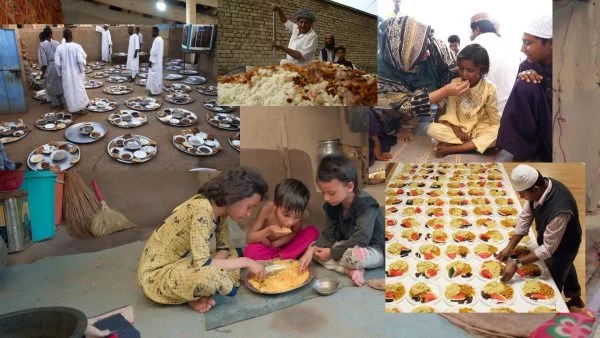
One of the other philosophies of sacrifice is feeding the poor and needy. The Holy Prophet (peace be on him and his household) brought a hundred camels with him for sacrifice in the Farewell Pilgrimage. He explained the philosophy of making sacrifice obligatory as addressing the needs of the poor and stated: therefore, feed them its meat.

It has been reported in a narration that Imam al-Sadiq (peace be on him) has said:

Imam al-Sajjad and Imam al-Baqir (peace be on them) would divide the meat of sacrifice into three parts; they would give one part to their neighbors, one part to the needy and would keep the third part for their family.

Even today, the meat of the slaughtered animal, under the supervision of the Islamic Development Bank and after being examined, is given to the visitors and needy who are present in Mina (a place situated to the east of Makkah and where some of the rites of Hajj are performed, including sacrifice). The rest is sent to 27 deprived Asian and African countries by land and sea.

One of the other purposes of sacrifice is the remembrance of Allah and remembering all the blessings, including the lawful livestock; and sacrifice becomes lawful through Allah’s remembrance.

“That they may witness the benefits for them, and mention Allah’s Name during the known days over the livestock He has provided them…” (Quran 22: 27, Qarai translation).

The Transcendental Philosopher, Rafiei Qazvini has stated regarded the secrets of Eid al-Adha: making a sacrifice on that day, has an apparent form and an esoteric one; its apparent form is to kill the animal which meets specific characteristics and features and its inner aspect is to kill one’s animal soul; because at the level of the animal soul, a human being is no different from an animal. The sacrifice on the day of Eid al-Adha is an indication of the sacrifice of the animal soul, not the rational soul. If Ismail (peace be on him) had been sacrificed, it would have been necessary to sacrifice a human being; however, that which must disappear in the course of way-faring is the level of animality, not rationality. This is because there are no obstacles in the domain of the intellect in the course of way-faring; however, there are many obstacles in this course in the animal faculty.

Imam al-Sadiq (peace be on him) also advises the performers of Hajj to

“slit the throat of one’s base desires and greed”.

The one performing Hajj knows that the sacrifice at Mina means to banish all material attachments, spiritual contamination, base desires, inappropriate lustful desires, and satanic temptations and he (the one performing Hajj) considers Mina to be the place of sacrificing and killing the base and inner desires of the soul and ego and decides there to distance himself from all that is other than God and to master the inner and outer devils.

And finally, the secret to reciting the ziyarah of Imam Husayn (peace be on him) on this day is for his remembrance and eternal revolution to be revived in the minds of people; for if Ibrahim, the Friend of Allah, took one sacrifice to Mina and returned him safely, Imam Husayn (peace be on him) brought seventy-two people for sacrifice at Karbala in one day and presented the severed heads and the bodies soaked in the blood of his companions and family members, from his breastfeeding infant to an old man, to Allah, all at one place for the sake of protecting Islam.

Compiler: Safura Taraqqi
Translator: Rashed
Relief Qurbani Today

Religion

Mubahila means invoking the divine curse to prove rightfulness and occurs between two parties who both claim to be right. This term refers to an event in Islamic history in which the Prophet (peace be on him and his household) suggested seeking God’s curse after a debate with the Christians of Najran and their not accepting Islam and they agreed to this suggestion. Despite this, the Christians of Najran refrained from this act on the promised day.

According to the Shiite belief, the event of the Prophet’s mubahila not only shows the rightfulness of the original invitation of the Prophet (peace be on him and his household) [to Islam] but also proves the superiority of his companions (Imam Ali, Lady Fatima, and Imam Hasan and Husayn peace be on them) in this event. Based on this, the Shiites believe that Imam Ali (peace be on him) is the soul of the Prophet according to the verse of mubahila.

The Story of the Mubahila of the Holy Prophet (peace be on him and household) with the Christians of Najran (Najran is a small city between Aden and Hadramout in a mountainous region) This event has been recorded in some historical and many exegetic sources of both the Shiite and the Sunni.

During the last years of the Prophet’s life, the voice of Islam had reached all corners of the world during that time. The Holy Prophet (peace be on him) strived to spread Islam by sending letters to the heads of countries and different regions. One of these letters was one that was sent to the Christians of Najran in 10 AH.

The letter states: In the name of the God of Ibrahim and Ishaq [Isaac] and Yaqoub [Jacob] (this is a letter) from Muhammad, the Prophet of God to the bishop of Najran. I praise the God of Ibrahim, Ishaq, and Yaqoub and invite you towards the worship of God [and away] from the worship of “servants”. I invite you to leave the mastership of the servants of God and come under the mastership of God. and if you do not accept my invitation, you must pay taxes to the Islamic government (and in return for this small sum it will defend your life and wealth) and otherwise, you are notified of danger.

Some Shiite historical sources add that verse 64 of the chapter of Aal Imran was also a part of this letter. In this verse God states the following: “Say, ‘O People of the Book! Come to a common word between us and you: that we will worship no one but Allah, that we will not ascribe any partner to Him, and that some of us will not take some others as lords besides Allah.’ But if they turn away, say, ‘Be witnesses that we have submitted [to Allah].’”

After receiving the Christians of Najran started consulting [one another] and decided that a group of their elders would be sent to Madina to debate and discuss with the Holy Prophet (peace be on him and his household). Ibn Hisham writes: A group of Christians of Najran composed of 60 people entered Madina to see the Propet and debate with him. Among them, there were 14 and among the 14 there were three who held the position of being the head and elders over others and were respected by the Christians of that time. One had the title of “Aqib” and was named “Abdul Masih”. Another had the title of “Sayyid” and his name was “Iyham”, while the third was a bishop known as “Abu Haritha b. Alqama”.

The Holy Prophet (peace be on him and his household) invited them to Islam; they did not accept and much dialogue and discussion followed. The Christians disputed with the Prophet regarding the rightfulness of their religion. They said: Isa (Jesus) is God and another group considered him to be the son of God, while a third group believed in trinity, that is, they believed in three Gods: the father, the son, and the holy spirit. Ibn Hisham writes: “The Christians said to the Prophet: If Jesus (peace be on him) is not the son of God, then who is his father? Verses of the Quran were revealed and explained his creation to be similar to the creation of Adam, the father of humankind.” The dispute and discussion between the Christians of Najran and the Holy Prophet (peace be on him and his household) continued. The Prophet refuted their words and replied to their questions with clear arguments and conclusive proofs.

However, the Christians still denied the truth and insisted on their beliefs. At this time, verse 61 of the chapter of Aal Imran was revealed and the Christians on Najran were invited to mubahila. The verse states: “Should anyone argue with you concerning him, after the knowledge that has come to you, say, ‘Come! Let us call our sons and your sons, our women and your women, our souls and your souls, then let us pray earnestly, and call down Allah’s curse upon the liars.’”

When the Christian representatives heard the suggestion of mubahila from the Prophet (peace be on him and his household), they looked at each other in amazement. They wanted time to think and consult in this regard. When the Christians returned to their elders and consulted them, their bishop said: tomorrow look if Muhammad (peace be on him and his household) comes with his family and children, then abstain from mubahila and if he comes with his companions, then do mubahila because there is nothing he can do.

According to the verse of mubahila, the Prophet must bring his children and women and those who were like himself along with himself and they were none other than Hasan b. Ali (peace be on him), Husayn b. Ali (peace be on him), Fatima al-Zahra (peace be on her), and Ali b. Abi Taleb (peace be on him).

Fakhr al-Din Razi, the author of the exegesis Mafatih al-Ghayb, expresses rightfulness in the following way when he comes to the verse of mubahila: when the Prophet (peace be on him and his household) came to the place of mubahila, he was wearing a cloak of black hair and was carrying Husayn (peace be on him) and holding the hand of Hasan (peace be on him); Fatima and Ali (peace be on them) too were following behind him. At that time, the Prophet said to them: “when I raise hands to curse [them], say amen.” Then at that very place of mubahila, the Prophet took Hasan, Husayn, Ali, and Fatima (peace be on them) under his cloak and recited the verse of tat-hir [verse 33 of the chapter of al-Ahzab] and in this way, he also introduced his Ahlulbayt [people of the house] and introduced their position to others.

Suddenly the illuminated face of the Prophet (peace be on him and his household) along with four other members of his family became visible to the Christians of Najran and they all looked at each other in amazement and shock. They were very surprised that he had brought his infallible dear ones and children and his only and unique daughter to the scene of mubahila and they all said that this man has a firm belief in his invitation and prayer. The bishop of Najran said: “I see faces which, once they raise their hands in prayer and ask God to dislodge the biggest mountain from their place, they will be dislodged and it is absolutely not right that we do mubahila with these illuminated faces and virtuous people because it is not unlikely that we will all be destroyed and the range of punishment extend and include all the Christians of the world and not one Christian be left in the world.

Seeing the situation, the group of representatives consulted with each and unanimously decided they would definitely not enter into mubahila and were willing to pay a sum every year as taxes; the Prophet (peace be on him and his household) expressed his satisfaction and it was decided that every year, in return for a small sum, the Christians would enjoy the benefits of the Islamic government.

It has been narrated that after a while, this event led to the conversion to Islam of two of the Christian leaders known as Sayyid and Aqib. By divine command, the mubahila between the Christians of Najran and the Holy Prophet (peace be on him and his household) demonstrated the rightfulness of the religion of Islam. Since the Christians of Najran had discovered this rightfulness, they were not ready to do mubahila. Apart from this, with the revelation of the verse of mubahila, once again one of the virtues of the Ablulbayt (peace be on them) was explained in the language of the Quran and the elevated position of the household of purity and infallibility was introduced to humankind.

The Place and Time of Mubahila Mubahila took place on the 24th of Dilhajj and in a region of Najran, which in the time of the Prophet, was outside the city of Madina and today it is within the city and a mosque has been build in that place known as Masjid al-Ijabah. The distance between this mosque and the Mosque of the Prophet (Masjid an-Nabi) is about two kilometers.

The region of Najran is one of the thirteen regions in the southwest of Arabia and has good weather. It is located in the border region between Saudi Arabia and Yemen. The entire area of this region is 360,000 kilometers with a population of more than 620 000 people. The city of Najran is at the center of this region. This region was a Christian populated area during the time of the Prophet and the Christian citizens continued to live there with the support of foreign Christian countries, North Africa, and the Roman emperor. The most famous of the historical artifacts of this region is “Ukhdudiya” which has been mentioned in the Quran in the chapter of al-Buruj regarding the People of Ukhdud. And even today the monuments of “Ukhdud” are among the visited monuments by tourists and researchers of historical artifacts.

The Messages of the Event of Mubahila There are many messages in the event of mubahila; including the following:

1. If a person believes in the goal, he is ready to place himself and his closest family members in danger

2. The last trump card and weapon of a believer is supplication

3. In gatherings of prayer, we should also take children along with us

4. Seeking help from the unseen comes after employing normal abilities

5. In supplication, the state of the people of prayer is important not their number. The group that was going to do mubahila was not more than five people

6. Men and women have a place beside each other in different religious scenarios

7. Ali b. Abi Taleb is the soul of the Prophet of God (peace be on him and his household)

8. The Ahlubayt of the Prophet are those whose prayers are answered

9. The children of a daughter, just like those of a son are one’s own children. Therefore, Imam Hasan and Husayn (peace be on them) are the children of the Prophet

10. Referring to the authentic Islamic sources shows that the following prominent personalities who have cited this event are the following: (Tafsir al-Namoona)

• Muslim b. Hujjaj Neyshapuri, the author of Sahih Muslim, one of the six trusted books of the Ahl al-Sunna, vol. 7, p. 120 (Muhammad Ali Sabih print, Egypt)

• Ahmad b. Hanbal in Musnad, vol. 1, p. 185 (Egypt print)

• Tabari in his famous exegesis under verse 61 of Aal Imran, vol. 3, p. 192 (Maymaniya print, Egypt)

• Hakim in Mustadrak, vol. 3, p. 150 (Haydarabad Dakan print)

• Hafiz Abu Naim Isfahani in Dalaʾil al-Nubuwwa, p. 297 (Haydarabad Dakan print)

• Fakhr Razi in his famous exegesis, vol. 8, p. 85 (al-Bahiyya print)

• And many more sources and authors such as Ibn Athir, Ibn Jowzi, Alusi, Tantawi, Zamakhshari, etc.

Wikifeqh.ir

Iribnews.ir

Translator: Rashed

Religion

Husayn (peace be on him) is the third Imam of the Shiites, the son of Ali b. Abi Taleb (peace be on him) (the first Imam of the Shiites) and Lady Fatima al-Zahra (the daughter of the Holy Prophet peace be on him and his household). He was born on the 3rd of Shaban in the year 4 AH (626 CE) and was martyred on the 10th of Muharram, 61 AH (680 CE).
He was martyred on the day of Ashura (10th of Muharram) on the plains of Karbala and in a battle with the army of Yazid (the son of Muawiyah and the ruler of the Islamic nation).

Due to his honorable spirit and since he was anti-oppressors, Husayn (peace be on him) did not accept Muawiya’s (the then caliph) request regarding the heir apparency of his son Yazid because he was an incompetent, corrupt, and immoral person.

After the death of Muawiya in 60 AH (October 680), Yazid enticed the cowardly and weak-hearted people of Kufa and they supported and paid allegiance to him, and prepared for battle with Imam Husayn (peace be on him), the grandson of the Holy Prophet (peace be on him and his household) at his command. And it was at that time that Imam Husayn (peace be on him) was on his way to Kufa with his family at the invitation and request of the people of Kufa; however, he encountered the disloyalty of the people of Kufa.

Of the prominent attributes of Imam Husayn (peace be on him) which are the Prophet (peace be on him and his household)’s legacy to him, were the beautiful attribute of bravery and resistance. A person is braver in society to the extent that he is stronger and more powerful against his internal desires. According to God’s words in the Quran and historical sources, the Holy Prophet (peace be on him and his household) possessed unparalleled bravery and was the bravest and strongest of heart in fighting against the enemies of Islam and Imam Husayn (peace be on him) had also inherited his unexampled bravery from his father, Imam Ali and his grandfather (peace be on them).

A prominent example of the bravery of Imam Husayn (peace be on him) and his companions in the battle between him and Yazid can be explained as follows: while the enemy had blocked water from Husayn (peace be on him), his children, and his companions, and the cries of thirst of the children could be heard; however, the companions of Imam Husayn (peace be on him) bravely fought the enemy and did not accept disgrace even at the cost of the lives of their loved ones in fighting against Yazid, and did not surrender to the enemy. So strong-hearted and powerful was he in battle, in these same difficult conditions, that the world has never witnessed such a warrior.

The conduct and method of the Ahlulbayt (peace be on them) and Imam Husayn (peace be on him) was such that the Prophet and his progeny never started a war. Even on the Day of Ashura, Imam Husayn (peace be on him) was not the instigator of the battle; however, when the battle started, the Imam and his companions stood tall and did not surrender.

The bravery and courage of Imam Husayn (peace be on him) was not limited to the Day of Ashura. He was unparalleled in his bravery and courage in his childhood and youth because he passed the first seven years of his life with his grandfather, Muhammad, the Prophet of God (peace be on him and his household). According to historical reports, Prophet Muhammad (peace be on him and his household) held intense love for Husayn and his brother Hasan al-Mujtaba (peace be on them). In one of his narrations, the Holy Prophet states: Hasan and Husayn are the Leaders and Chiefs of the youth of Paradise.

In general, the words and methods of Imam Husayn (peace be on him) are honorable. Only one of the dimensions of Imam Husayn’s uprising and resistance is that he was oppressed; however, the other aspect is dignity and an epic.

The words of Imam Husayn (peace be on him) show his bravery and dignity, that is, from the time that Imam Husayn is asked to pay allegiance to Yazid (the unworthy and corrupt son of Muawiya), he speaks with dignity and says in that same gathering: Islam must be bid farewell to when Islam becomes afflicted with an undeserving and corrupt ruler such as Yazid. At that very place, he completely rejects Yazid. This way of taking a position is a position of honor and dignity.
Imam Husayn (peace be on him)’s policy was such that he would state:

Death is more worthy and admirable than that I surrender to disgrace and similarly, enduring not surrendering to the wishes of the enemy is better than entering the fire of hell and the fire of God’s wrath.

Imam Husayn (peace be on him)’s resistance and not agreeing to surrender to the enemy is an abiding lesson for liberal thinkers such as Gandhi and Nelson Mandela in contemporary centuries as well.
One of Gandhi’s statements is as follows: If India wishes to be victorious; it must follow the policy of Imam Husayn (peace be on him).

If we consider Gandhi’s praise and Nelson Mandela’s understanding of Imam Husayn (peace be on him), we will see that if both and thousands of others who have, at different occasions, introduced themselves as students of Imam Husayn ([eace be on him) did not know him, would they have achieved their goals?

Sources:

• Speech on the 7th anniversary of the death of Imam Khomeini

• Mathir al-Ahzan, Ibn Nama Hilli

• Ithbat al-Wasiyya, Ali b. Husayn Masoudi

• Amali, Shaykh al-Saduq

• Luhuf, Sayyid Ibn Tawus

translator: Rashed

Religion

Shia’s fourth Imam is named Ali. He is the son of Hussain-ibn-Ali (Peace Be Upon Him), Shia’s third Imam. He was given the epithet “Sajjad”, meaning constantly praying, and “Zein-al-Abedin”, meaning the adornment of worshippers. Imam Sajjad was born in 38 AH(Lunar Calendar) corresponding to 659 AD(Georgian Calendar) his mother, Shahrbanoo, came from an Iranian clan.
Imam Zein-al-Abedin was present in the ،Tragedy of Karbala along with his father and his family, but by the will of Allah, he was very ill during the war of Karbala and could not fight in that Jihad. Although he was desperate to take part in the war, His magnanimous father did not allow him to do so. So that by the will of Allah, the earth shall not be devoid of his “Hojjah”. In the Tragedy of Karbala, where Imam Hussain, his brother ,Abalfazl-al-Abbas, and several of Imam Sajjad’s cousins were martyred, By the order of “Allah” and according to Prophet Muhammad ‘s will; “Imamate” (leadership of the people), after Imam Hussain, was bestowed upon his son Ali-ibn-al-Hussain, and thus Imam Hussain delivered his son with all the necessary devine secretes, before his martyrdom.
Imam Sajjad’s illness didn’t last long and after that, being a powerful young man of about 24, he took over the responsibility of leading the nation.

Imam Sajjad’s era and the carrying out of his mission
Imam Sajjad’s Imamate period was abound with hardship and this time went as the magnanimous Imam and his followers suffered immense oppressions, because of the numerous obstacles in the way of his leadership and guidance of the society. On the one hand those who unjustly reigned over the Islamic society in the government where the very ones who had martyred Imam Hussain and his family in the most unimaginably brutal and ruthless way. on the other hand those ostensibly Muslim rulers, “Khalifs”, in reality were the most corrupt and oppressive people ever. because of the plot contrived and spread by the government, ignorance and aberration was rampant in the society. Throughout that excruciatingly tough time, Imam Zein-al-Abedin(PBUH) was in pursuit of a number of goals in line with accomplishing his divine Imamate mission and fulfilling his sacred responsibility. First and foremost, he attempted to keep the memory of the tragedy of “Ashura” alive by citing the events and facts of that day. Imam carried out this important deed through his fiery orations. A good example of this is his famous oration in Yazid-ibn-Muawiyah’s court when Imam Sajjad and his family were taken captive. Yazid, was then the ruler of the Islamic states. There in the presence of Yazid and his throng of supporters, Ali-ibn-al-Hussain with all bravery and unbelievable soul power delivered an enlightening speech which made the audience cry and come to a realization of truth.
In line with such enlightening deeds, whenever he wanted to drink water or eat food, Zein-al-Abedin would commemorate his father and other martyrs of Karbala, who had been killed as they were thirsty.
Imam’s second goal was to prevent the elimination of the truths and principles of the true Islam at the hands of tyrant rulers and their proponents or because of ignorance or ill intention of some people.
His next goal was to elucidate the principle of “Imamate” and “Vilayah” to the people, so that the society would truly understand what leadership of the Islamic society means, what responsibilities the prophet’s successor has, and who Allah’s true Khalifa, people’s Imam and leader on earth is. Imam Sajjad (PBUH) corrected the concept of “Imamate” in people’s minds. He announced to truth seekers that he was the rightful Imam and not the ruler of the day who by deception was misleading the society.

Considering the repression and severe dread of government among people, Imam Zein-al-Abedin managed these goals through some intelligent schemes.

Stating pray and devotions was among the most important means used by him to guide people. He gave insight to audiences using prays, restoring the Shia party by patience and expectancy culture policy.

A set of most sophisticated and magnificent prays of Imam Sajjad is collected in “Al-Sahifa al-Sajjadiyya” book, known as “Zabur Ale Muhammad” which presents a collection of scientific, ethical and Islamic sciences in form of words, prays and devotions.

Imam Sajjad (bless upon him) had to devise a plan to revive the true Islam in his lonely exile. According to authentic historical references, while he had not more than 20 companions in Medina, Imam Sajjad trained many students to deliver the pure Islamic sciences to people and eliminate ignorance in the society.

Through this way, for restoration of prophet missed sunna, he started training slaves. He named his salves, children and called them “My Son”. With this action, he wanted to intimate that there is no difference between a free Muslim and a slave in his opinion. Imam Zein-al-Abedin never punished his slaves but he put down their mistakes and gathered them at the end of Ramadan, reading it for them and asking them to leave those behaviors. He asked them to ask God forgive him as he has forgiven them. Then he gave them a gift and manumitted them for sake of God, turning them into messengers for spreading Islamic science and ethics. Moreover, Imam granted the needed facility for a good and independent life to them. By this method, an army of more then 50 thousands manumitted men and women was prepared who were in Imam Sajjad’s power. Some of these manumitted people whom were trained in Imam’s school turned into prominent scientists like Hasan bin Saeed Ahvazi, Husain bin Saeed Ahvazi, Ahmad bin Husain bin Saeed and Shuaib.

Like other Ahl al-Bayts, Ali bin Husain was generous, forgiver and helpful to poor people and respected them by sharing meals. For instance, he carried food and breads at nights personally, delivering it to poor people and orphans anonymously.

Imam Sajjad martyrdom (God bless him)
As time went on, the Omavi system figured out the confrontation methods of Imam Sajjad and concluded that having Imam alive in the society is a threat to their government. Moreover, Abdulmalek, hisham -the ruler at the time- , Valid and even some elites of Umayyad dynasty were envious of him since people admired Imam due to his wisdom and intelligence. Moreover, they decided to murder him because of his revealing about Ashura and the assumption that Imam was planning to rise against the government. They murdered the 4th Imam of Shias by poison at the age of 57, on 25 Muharram 95 Hijri, in AD 713 after 35 years of imamate.
His holy shrine is located in Medina alongside his uncle Imam hasan, Imam Bagher and Imam Sadegh’s shrine in Jannat al-baqi.

Religion

Grand Ayatollah Sayed Hossein Borujerdi

Father Name: Hajj Seyed Ali

Date of birth: Islamic date: Safar 1292 / English date:   23 March 1875

Birth Place: Boroujerd, Iran

Places of Education: Boroujerd, Isfahan, Najaf, Mashad and Qom.

Place of Burial: Holy Shrine of Hazrat Masoumeh(PBUH) in city of Qom on 13th of Shawal 1380 / 31 March 1961 (aged 88).

Grand Ayatollah Sayed Hossein Borujerdi (March 1875 – 30 March 1961) was an Muslim Shia Marjah and the leading Marjah in Iran from roughly 1947 to his death in 1961.  For more than 15 years he was known as a highest-level Shia authority, a Grand Ayatollah with the authority to make legal decisions within the confines of Islamic law for followers and less-credentialed clerics. He was also the chairman of educating institution (sometimes called seminarians or Howzat) in theology, to prepare students for ordination as clergy.

Grand Ayatollah Sayed Hossein Borujerdi put remarkable efforts on development of religious and cultural places and seminarians, libraries and publishing religious books. For instance, Azam mosque of Qom, Islamic Centre Hamburg, Jahangir Khan Religious School, Kermanshah Religious School, Najaf Ashraf school as well as multiple libraries in Kermanshah and Najaf were built during his life.

In 12 February 1960, he ordered foundation of large public library in Azam mosque of Qom. The opening ceremony was officially held in 13 April 1961 by his son Mohammad Hossain Borujerdi, Ayatollah really tends to the public use of the library. The library was headed by Ayatollah Danesh Ashtiani.

Ayatollah Sayed Javad Alavi Boroujerdi (his grandson), is responsible for Azaam Grand Mosque, library and other related centers with his order, the library building was renovated and reopened in 2009 and a separate section was considered for women.


In 2002, Ayatollah Boroujerdi Library was selected by the Public Libraries Foundation as the best library of Qom province and afterwards in 2005 the Department of Culture and Islamic Guidance of IR Iran nominated and appreciated this library for providing superior service

In 2011, Grand Ayatollah Boroujerdi Library in recognition and appreciation of remarkable services to researchers was named as a Selected Library by the Academic Council of 13th Annual Book Symposium of Howzat.

Religion